Nearly one in four young Vancouver homeowners bought with their parents. Co-ownership is no longer a workaround. Here's how it works, what to watch for, and which mortgage products support it.
Here is something that would have felt strange to say ten years ago: buying a home with your parents is now one of the most common ways young people get into the Vancouver market. It is not a backup plan. It is the plan.
I have watched this shift happen in real time. A decade ago, maybe one in ten of my younger buyers had a parent on title. Now it feels closer to one in three. The data backs that up. According to Statistics Canada and Central 1 Credit Union research, roughly 23.4% of Vancouver homeowners born in the 1990s co-own their property with a parent. The national average is about 17%. BC leads the country.
And it is not just parents and kids. I am seeing friends buy together, siblings pool resources, and even colleagues with complementary work schedules share a duplex. The common thread: nobody can afford to go it alone in a city where the composite benchmark price sits at $1,114,800.
Why Co-Ownership Is Exploding in Vancouver
The math is pretty simple. A single person earning Vancouver’s median household income cannot qualify for a mortgage on a median-priced home. Not even close. The stress test means you need to qualify at roughly 6.5-7% even though actual rates are around 4-4.5%. That eliminates a huge swath of solo buyers.
Add a second income to the application, though, and the picture changes. Two incomes on a mortgage application can double your qualifying amount. A parent who owns their home outright and co-signs can provide the equity to avoid CMHC insurance entirely. And families who pool for a larger down payment reduce the total debt from day one.
According to Central 1 Credit Union, about 84% of parent-child co-ownership cases in Vancouver are situations where the property is the child’s only home while the parents own other properties. The parent is there for financial backing, not because they are moving in. In the remaining cases, about 34% involve multi-generational living where both families share the home.
There is a cultural dimension too. In Vancouver, 76.9% of parents who co-own with their adult children are immigrants, according to StatsCan data. Many immigrant families treat real estate as a multi-generational family asset. It is a strategy that has been working in places like Hong Kong, Singapore, and Mumbai for decades. Vancouver is just catching up.
The Two Legal Structures You Need to Understand
If you are going to co-own, you need to decide how you hold title. This is not a trivial decision. It affects what happens if someone dies, wants to sell, or gets divorced.
Joint Tenancy
All owners have equal shares. If one owner dies, their share automatically passes to the surviving owner(s). This is what most married couples use. It is simple, but it means you cannot leave your share of the home to someone else in your will.
Best for: Parents and children who want automatic survivorship. Married couples buying with another couple.
Tenants in Common
Each owner holds a defined percentage. You can own 60/40, 70/30, or whatever reflects each party’s financial contribution. If one owner dies, their share goes to their estate (i.e., whoever they named in their will), not automatically to the other owner.
Best for: Friends buying together. Siblings with unequal contributions. Any arrangement where you want your ownership percentage to reflect what you actually put in.
In my experience, tenants in common with a well-drafted co-ownership agreement is the safer route for anyone other than a married couple. I have seen joint tenancy create headaches when one party’s circumstances change.
Mortgage Products That Actually Support Co-Ownership
Not all mortgages treat co-owners the same way. A standard joint mortgage from one of the big banks puts everyone on the same rate, same term, same payment schedule. That works fine for some people but creates problems for others.
Vancity Mixer Mortgage
This is the standout product in BC. Vancity’s Mixer Mortgage lets each co-owner choose their own rate (fixed or variable) and their own term. You get separate statements. If one person wants a 5-year fixed and the other wants a 3-year variable, you can do that on the same property.
The catch: it is still joint and several liability. If your co-owner stops paying, you are on the hook for the full amount. The Mixer just gives you flexibility on the terms, not an escape hatch.
Available in: British Columbia only.
Big Bank Joint Mortgages
TD, RBC, Scotiabank, BMO, and CIBC all allow joint mortgages with up to four applicants. You share one mortgage, one rate, one term. It is simpler, but everyone is locked into the same structure. Most also support both joint tenancy and tenants in common on title, which gives you some flexibility on the ownership side even if the mortgage is shared.
Coast Capital Savings
Another BC option. They do not have a branded co-ownership product, but they actively work with friends and family buyers and offer high-ratio mortgages for groups with less than 20% down.
What Properties Work Best for Co-Ownership
Not every home makes sense for shared living. Over 20 years, I have seen what works and what does not.
Vancouver Specials
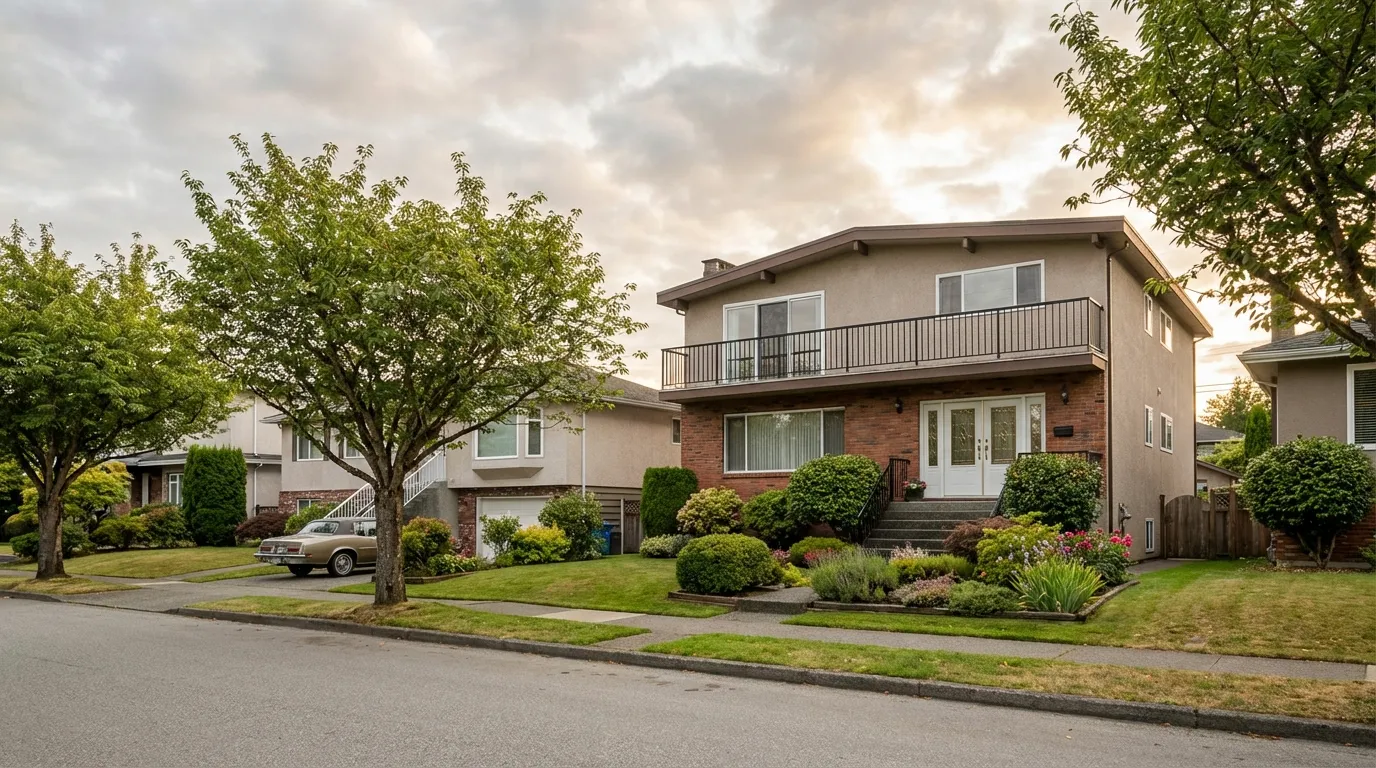
These are the gold standard for co-ownership in Vancouver. The classic boxy two-storey design with distinct upper and lower floors was practically built for two families. Separate entrances, separate kitchens, clear boundaries. You can find them all over East Vancouver, Main Street, and Collingwood for $1.5-2M, which splits to $750K-$1M per family.
Homes with Laneway Houses
A detached home with a laneway house gives you complete physical separation. One family takes the main house, the other takes the laneway. The only shared element is the lot and the property taxes. In Kitsilano and Dunbar, these are increasingly popular with parent-child arrangements where the parents take the smaller laneway unit.
Duplexes and Side-by-Sides
True duplexes with separate titles are ideal because each party can own their unit outright. Stratified duplexes are becoming more common under Bill 44 multiplex zoning. Where you find side-by-side options, you get separate financing and cleaner exit strategies.
What Does Not Work
Shared condos where both parties live in the same unit. It sounds fine at 25 when you and your best friend are splitting a two-bedroom. It becomes a nightmare at 32 when one of you gets married and wants to bring a partner in. I have seen this go sideways more times than I can count.
The Co-Ownership Agreement: Non-Negotiable
I tell every co-buying client the same thing: get a co-ownership agreement drafted by a real estate lawyer before you close. Not after. Not “when we get around to it.” Before.
This document should cover:
- Ownership percentages and how they were calculated
- Who pays what: mortgage, property tax, insurance, maintenance, upgrades
- Decision-making: What requires unanimous agreement? What can one party decide alone?
- Exit strategy: What happens when someone wants out? Right of first refusal? Timeline for buyout?
- Dispute resolution: Mediation before litigation. Always.
- Death or incapacity: Does the agreement override or complement the will?
- New occupants: Can a partner or spouse move in? Under what conditions?
A good co-ownership agreement costs $1,500-3,000 to draft. That is nothing compared to the cost of a legal dispute over a $1.5 million asset with no rules in place. I have seen friendships end and family relationships fracture over co-ownership disagreements that a simple document could have prevented.
The Tax Implications
This is where people trip up. Two things to know:
Principal Residence Exemption: Each individual can only claim one property as their principal residence. If a parent co-owns but does not live in the home, their share of any capital gain on sale is taxable. This matters more than people realize. Talk to your accountant before structuring the deal.
Property Transfer Tax: BC’s property transfer tax applies on the full purchase price. First-time buyer exemptions may apply to one co-owner but not the other. If the parent already owns a home, they do not qualify for the first-time buyer exemption on their portion. Again, get tax advice specific to your situation.
Key Takeaways
- About 23% of young Vancouver homeowners co-own with a parent, well above the national average of 17%
- Tenants in common with a detailed co-ownership agreement is the safest structure for non-spousal co-buyers
- Vancity’s Mixer Mortgage is the most flexible co-ownership mortgage product in BC, allowing separate rates and terms
- Vancouver Specials, homes with laneway houses, and stratified duplexes are the best property types for shared living
Frequently Asked Questions
Can you buy a house with a friend in Vancouver?
Yes. Any two or more people can purchase property together in BC. You can hold title as joint tenants or tenants in common. Most major lenders accept joint mortgage applications with up to four people. The critical step is getting a co-ownership agreement drafted by a lawyer that covers expenses, decision-making, and exit strategies.
What is the Vancity Mixer Mortgage?
The Vancity Mixer Mortgage is a co-ownership mortgage product available in British Columbia that allows each co-owner to choose their own rate type (fixed or variable) and their own mortgage term. You share one property and one mortgage, but your payment structures can differ. Liability is still joint and several, meaning each party is responsible for the full mortgage if the other defaults.
Do you need a lawyer for co-ownership in Vancouver?
You do not legally need a lawyer specifically for a co-ownership agreement, but I strongly recommend one. A lawyer will draft a co-ownership agreement covering ownership percentages, expense sharing, exit terms, and dispute resolution. The cost is typically $1,500-3,000, which is minimal compared to the risk of an unstructured arrangement on a property worth over $1 million.
What happens if one co-owner wants to sell?
It depends on your co-ownership agreement. A well-drafted agreement will include right of first refusal (the other owner gets the first chance to buy out the departing party), a timeline for the buyout, and a process for determining fair market value. Without an agreement, you may need to go through a court-ordered partition and sale, which is expensive and adversarial.
Sources
- Statistics Canada - Co-Ownership Trends, Canadian Housing Survey
- Central 1 Credit Union - Parent-Child Co-Ownership in Vancouver Research
- Greater Vancouver Realtors - December 2025 Market Statistics
- Vancity - Mixer Mortgage Product Information
Data sourced February 2026. Co-ownership structures have legal and tax implications that vary by situation. Consult a lawyer and accountant before proceeding.
Next Steps: Work with Rain City Properties
Co-ownership deals are more complex than a standard purchase. There are more people at the table, more opinions on what to buy, and more financial scenarios to model. Having an agent who has structured these deals before makes a difference.
I have helped dozens of families and friend groups navigate co-ownership purchases across Vancouver’s west side. If you are thinking about buying with someone else, I can walk you through the numbers and connect you with lawyers and mortgage brokers who specialize in these arrangements.
Contact Greyden Douglas directly at (604) 218-2289 or book a call to discuss your Vancouver real estate goals.