The federal government just introduced legislation to turn Build Canada Homes into a permanent Crown corporation with $13 billion and the power to build directly on public land. Here's what it actually means for Vancouver's housing pipeline — and what the track record suggests about delivery.
Ottawa wants to build houses now. After years of funding programs that mostly produced announcements and pilot projects, the federal government is putting $13 billion behind a new Crown corporation whose job, on paper, is to actually construct homes on public land using factory-built components. It is called Build Canada Homes, and on February 5, 2026, the government introduced the Build Canada Homes Act (Bill C-20) to make it permanent.
I have been selling real estate in Vancouver for 20 years. I have seen federal housing announcements come and go. Most of them land as press releases and funding commitments that take years to move dirt. So when I read the details on Build Canada Homes, I did what any reasonable person would do: I read the fine print, cross-referenced the Parliamentary Budget Officer’s numbers, and tried to separate the policy from the promise.
Here is what I found.
What Build Canada Homes Actually Is
Build Canada Homes launched on September 14, 2025, as a special operating agency under Housing, Infrastructure and Communities Canada. Led by CEO Ana Bailao (former Toronto Deputy Mayor and Chair of the Planning and Housing Committee), it was set up with a specific mandate: build affordable housing using public land and modern construction methods, and do it faster than the existing system can.
The Build Canada Homes Act would convert that agency into a Crown corporation, giving it independent governance, a board of directors, and the legal authority to:
- Acquire, develop, and build on federal land
- Take over Canada Lands Company’s land holdings and development experience
- Deploy flexible financial instruments including concessional loans
- Partner with provinces, municipalities, Indigenous communities, and private developers
- Borrow up to $400 million from non-federal sources
The budget is $13 billion over five years, of which $11.6 billion is new money according to the Parliamentary Budget Officer.
That is a lot of money. Whether it produces a proportional amount of housing is the question worth asking.
The Build Canada Homes Act: Bill C-20
Bill C-20 was introduced in Parliament on February 5, 2026, with second reading debate taking place on February 23. The legislation does two main things.
First, it formalizes BCH as a permanent institution. This is not another program that sunsets in five years. A Crown corporation has its own board, its own CEO, its own budget cycle. If you are old enough to remember Canada Mortgage and Housing Corporation’s early decades, this is a similar structure.
Second, it authorizes the transfer of Canada Lands Company’s portfolio. CLCL has been sitting on federally owned properties across the country for decades. Some of those sites are well-located, serviced, and ready for development. The idea is that BCH can bypass years of land acquisition and get straight to building.
My read: formalizing BCH as a Crown corporation is the right structural move. Agencies attached to departments get shuffled around with every cabinet change. Crown corporations have more operational independence. Whether that independence translates to speed is another matter.
The BC Partnership: $810 Million for 1,100 Homes
On February 18, 2026, BCH and BC Housing announced a joint commitment to build at least 1,100 new homes in British Columbia:
- 700 supportive and transitional homes to start construction within 12 months
- 400 affordable rental homes built through BC’s DASH program
The money breaks down like this:
| Source | Contribution |
|---|---|
| Build Canada Homes (federal) | $170 million in capital |
| BC Housing (provincial) | $200 million in capital + $27 million/year in operating costs for 10 years |
| Total | $810 million |
Source: Canada.ca - Canada and BC Partnership Announcement, Feb 18, 2026
I want to be transparent about what 1,100 homes means in context. Metro Vancouver alone needs roughly 8,000 to 10,000 new homes per year just to keep up with population growth. So 1,100 homes province-wide is a start, but it is not going to move the needle on affordability by itself.
The BC government framed this as “phase one”, with commitments to deliver “thousands of more units” in future phases. I’ll believe the future phases when shovels are in the ground.
The DASH Program: From Three Years to One
The more interesting piece of the BC partnership is the DASH program (Digitally Accelerated Standardized Housing). DASH uses pre-approved blueprint designs, prefabricated components manufactured in BC, and digital coordination to compress the development timeline from three years to roughly one year.
Think of it as a kit-of-parts system. Prefabricated wall assemblies, floor cassettes, mass timber systems, and drop-in mechanical systems that get assembled on site instead of built from scratch. BC Housing has been piloting this approach, and the 400 affordable rental homes in the federal partnership are supposed to be delivered this way.
If DASH works at scale, it could matter a lot more than the dollar amount suggests. The biggest barrier to affordable housing in Vancouver is not just money. It is time. A project that takes three years from approval to occupancy costs more than one that takes twelve months, because every month of delay adds carrying costs, escalating construction prices, and lost rent revenue.
Direct Build Projects: The Six Sites
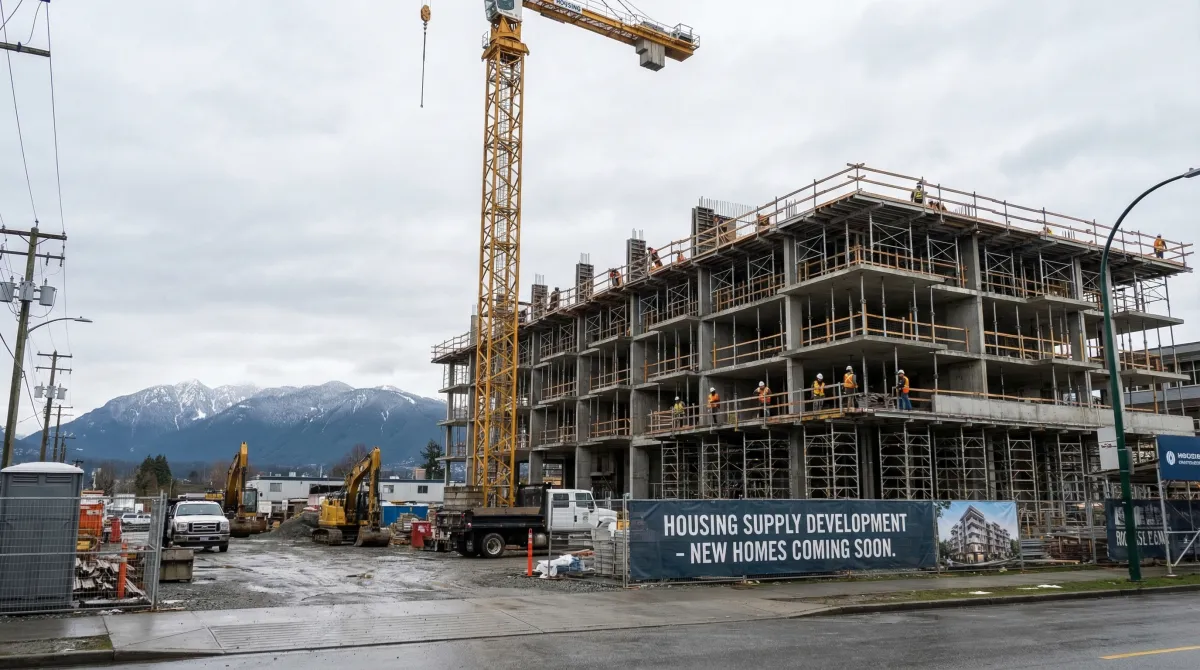
BCH has advanced six “Direct Build” projects across Canada using federal land. None are in BC, but they show the model BCH plans to scale:
| Project | Location | Units | Notes |
|---|---|---|---|
| Arbo Downsview | Toronto | 540 | Minimum 40% affordable, modern construction methods |
| Heron | Ottawa | 1,100 | 18-acre federal site |
| Pointe-de-Longueuil | Longueuil, QC | 1,055 | St. Lawrence waterfront |
| Shannon Park | Dartmouth, NS | 630 | Mixed-market, first phase |
| Naawi-Oodena | Winnipeg | TBD | Treaty One First Nations partnership |
| TBD | Edmonton | TBD | Details not yet announced |
Source: Canada.ca - Build Canada Homes Act Backgrounder, Feb 5, 2026
Combined with the four provincial/territorial partnerships (BC, Nova Scotia, Quebec, and Nunavut), the government says these initiatives represent more than 7,500 new homes.
Construction on the Direct Build sites is expected to start in summer/fall 2026. For Vancouver buyers wondering when federal construction actually reaches BC, the answer is: the 700 supportive homes from the BC partnership are the closest thing in the pipeline, and even those are 12 months from construction start, not completion.
GST Elimination for First-Time Buyers: The $50,000 Question
Separate from Build Canada Homes but running on a parallel track, the federal government is eliminating the GST on new homes for first-time buyers through Bill C-4 (the Making Life More Affordable for Canadians Act).
Here is how the savings work:
| Home Price | GST Rebate | Effective GST Rate |
|---|---|---|
| Up to $1,000,000 | Up to $50,000 (100% of GST) | 0% |
| $1,000,000 - $1,500,000 | Linear phase-out | Partial |
| Above $1,500,000 | $0 | Full 5% |
Source: Department of Finance Canada - GST Relief for First-Time Home Buyers, May 2025
The Senate completed third reading on February 26, 2026, and the bill is expected to receive Royal Assent in early March 2026. Eligibility requires the purchase agreement to be signed on or after May 27, 2025.
Who qualifies
You need to be a Canadian citizen or permanent resident, at least 18, and you cannot have owned a home in Canada or elsewhere in the current year or the previous four calendar years. It applies to new construction purchased from a builder, owner-built homes, and co-op housing shares.
What this means in Vancouver
Let me do the math on a typical scenario. A first-time buyer purchasing a new $950,000 condo in Mount Pleasant would save roughly $47,500 in GST. On a $750,000 new townhome in an outlying area, the savings would be $37,500. That is real money, equivalent to about two years of strata fees on most buildings.
But here is the catch that people miss: this applies to new construction only. In Vancouver, about 75-80% of transactions involve resale properties. So the GST elimination helps first-time buyers who are purchasing presale condos or new builds, not those buying a 1970s bungalow in Kitsilano.
The calculations above are for illustration only. The GST is 5% of the purchase price before land value. Exact rebate amounts depend on the specific transaction. Consult your accountant or tax advisor for your situation.
The Reality Check: Federal Housing Promises vs. Delivery
Here is where I put on my skeptic hat. And I think this context matters if you are making any real estate decisions based on federal supply projections.
The PBO’s numbers are sobering
The Parliamentary Budget Officer estimated in December 2025 that Build Canada Homes will produce approximately 26,000 housing units over five years. That is a 2.1% increase in total housing completions relative to baseline. For a country that says it needs to double housing construction, 2.1% is not doubling anything.
And it gets worse. The PBO also found that overall federal housing spending is set to decline 56% from $9.8 billion in 2025-26 to $4.3 billion in 2028-29, as older programs expire and Budget 2025 cuts take effect. So BCH’s $13 billion is partly replacing money that is disappearing from other housing programs.
The track record is not reassuring
The Fraser Institute pointed out that the federal government’s history of managing its own real estate does not inspire confidence. Ottawa acknowledged in 2017 that half its office space was underused. It took until 2019 to formulate a plan, and by 2023, the federal footprint had barely moved, from 6.0 million to 5.9 million square feet.
More directly relevant: the National Housing Strategy committed $82 billion starting in 2017. A federal lands initiative within that strategy allocated $200 million specifically for 4,000 homes on government land. It produced 309.
I want to be fair. Build Canada Homes has a different structure, a more focused mandate, and a CEO with actual development experience. Ana Bailao built her career on housing policy in Toronto. The model of using prefab and modular construction to accelerate timelines is sound in theory. But scaling from theory to thousands of units across the country is where every previous initiative has stumbled.
Competing mandates add risk
The Fraser Institute also flagged something I have heard from builders: BCH has requirements to use Canadian-made materials and prioritize sustainable construction. Those are fine goals in isolation, but they add cost and complexity. Domestic prefab manufacturing capacity is limited. If BCH is competing with the private sector for the same modular builders and construction workers, it could push costs up rather than down.
My honest read: Build Canada Homes will produce some housing, and some of it will be genuinely affordable. But if you are a Vancouver buyer waiting for federal construction to fix the supply crisis, you are going to be waiting a long time.
What This Means for Vancouver’s Supply Pipeline
So where does this leave Vancouver? Let me connect the dots.
Short-term (2026): The 700 supportive and transitional homes from the BC partnership will start construction within 12 months. These are important for people experiencing homelessness and housing instability, but they are not market housing and will not directly affect purchase prices or inventory for typical buyers.
Medium-term (2027-2028): The 400 DASH affordable rental homes should start materializing. If the DASH model proves it can compress timelines to one year, expect the province to scale it. This is the piece I am watching most closely because it addresses the process problem, not just the money problem.
Longer-term (2028+): BCH’s Direct Build model could eventually reach BC through future federal land sites. The government has not announced specific BC sites yet, but the Canada Lands Company portfolio includes properties in the lower mainland.
Meanwhile, Vancouver’s private-sector supply pipeline is under pressure. CMHC reported that condo starts in Vancouver fell 13.4% in the first half of 2025, and presale cancellations have stalled or postponed multiple projects heading into 2026. The GST elimination for first-time buyers could help revive some presale demand, which would indirectly support new construction.
The bottom line is that Vancouver’s supply problem needs solutions from every level of government and the private sector working simultaneously. Build Canada Homes is one piece. Bill 44 multiplex rezoning is another. The Broadway Plan is another. None of them alone is sufficient.
Key Takeaways
- Build Canada Homes is becoming a Crown corporation with $13 billion and the power to build directly on federal land, with six initial projects totaling approximately 4,000 units across Canada (none in BC yet)
- The Canada-BC partnership commits $810 million for 1,100 homes in BC, with 700 supportive/transitional units starting construction within 12 months and 400 affordable rentals through the DASH prefab program
- The GST elimination for first-time buyers on new homes under $1 million (saving up to $50,000) is expected to receive Royal Assent in early March 2026 and could help revive presale demand
- The Parliamentary Budget Officer projects BCH will produce 26,000 units nationally over five years, a 2.1% increase, while overall federal housing spending declines 56% as other programs expire
- Vancouver’s supply crisis needs simultaneous action from federal, provincial, and municipal governments plus private development. BCH is one piece, not the solution
Frequently Asked Questions
What is Build Canada Homes and when was it created?
Build Canada Homes is a federal housing agency launched on September 14, 2025, that is being converted into a Crown corporation through the Build Canada Homes Act (Bill C-20), introduced February 5, 2026. It has a $13 billion budget over five years and a mandate to build affordable housing on public land using modern construction methods like modular and prefabricated building.
How much will first-time buyers save on GST under the new rules?
First-time buyers purchasing new construction homes up to $1 million can save up to $50,000 through the full elimination of the 5% GST. The savings phase out linearly for homes between $1 million and $1.5 million. The rebate applies only to new homes, not resale properties. The legislation (Bill C-4) is expected to receive Royal Assent in early March 2026.
Will Build Canada Homes build housing in Vancouver?
Not directly through the current Direct Build projects, which are in Dartmouth, Longueuil, Ottawa, Toronto, Winnipeg, and Edmonton. However, the Canada-BC partnership announced February 18, 2026, commits to 1,100 homes across British Columbia, including 700 supportive/transitional units and 400 affordable rentals through the DASH prefab program. Future BCH phases may include BC sites as Canada Lands Company properties transfer to the agency.
How many homes will Build Canada Homes actually build?
The Parliamentary Budget Officer estimates approximately 26,000 units nationally over five years, representing a 2.1% increase in housing completions. The government’s own announcements reference more than 7,500 homes from current projects and partnerships, with capacity for up to 45,000 units across the full portfolio. The gap between the PBO estimate and government targets is significant.
What is BC’s DASH program and how does it speed up construction?
DASH (Digitally Accelerated Standardized Housing) uses pre-approved building designs, prefabricated components made in BC, and digital coordination to cut the development process from approximately three years to one year. It uses a kit-of-parts approach with prefab wall assemblies, floor cassettes, mass timber systems, and drop-in mechanical systems. The 400 affordable rental homes in the BC partnership will use this method.
Sources
- Government of Canada - Introduction of the Build Canada Homes Act, February 5, 2026
- Government of Canada - Build Canada Homes Act Backgrounder, February 5, 2026
- Government of Canada - Canada and BC Partnership to Build More Homes, February 18, 2026
- Parliamentary Budget Officer - Build Canada Homes and the Outlook for Housing Programs under Budget 2025, December 2025
- Department of Finance Canada - GST Relief for First-Time Home Buyers, May 2025
- Parliament of Canada - Bill C-20 LEGISinfo
- Fraser Institute - Federal Government Wants to Build 4,000 Homes Despite Years of Mismanagement
- BC Government - Fast-tracking Homes Across BC with Federal Support, February 2026
- CMHC - Slowdown in Toronto, Vancouver Leave National Housing Starts Flat, 2025
Data sourced February-March 2026. Federal housing policy and programs are subject to legislative approval and may change. Verify current details before making financial decisions.
Next Steps: Work with Rain City Properties
Federal policy can shift the playing field, but your individual real estate decisions still come down to local market conditions, timing, and personal finances. Whether you are a first-time buyer looking to take advantage of the GST elimination on a presale condo, or a homeowner weighing the long-term supply outlook before selling, the details matter.
I track these policy changes because they affect how I advise clients. If you want to talk through how Build Canada Homes, the GST rebate, or Vancouver’s evolving supply picture affects your situation, I am happy to have that conversation.
Contact Greyden Douglas directly at (604) 218-2289 or book a call to discuss your Vancouver real estate goals.
Related Vancouver real estate pages
Continue with local service pages, neighbourhood guides, and actionable resources related to this topic.