The BC government dropped its 2026 budget with school tax hikes on $3M+ homes, a bumped-up speculation tax, costlier property tax deferments, and expanded PTT exemptions for rental builders. Here's a plain-language breakdown of what actually changes and what it costs you.
BC Finance Minister Brenda Bailey introduced Budget 2026 on February 17, and the housing headlines landed exactly where most Vancouver property owners were hoping they would not: higher taxes on homes over $3 million, a steeper speculation tax, and a property tax deferment program that just got meaningfully more expensive to use.
There is some good news mixed in. Developers building purpose-built rentals got an expanded PTT exemption. And if you are a Canadian citizen living in your home, the speculation tax changes do not directly touch you. But the net effect of this budget is clear: Victoria is pulling more revenue out of BC real estate, and some of these changes will be felt on the west side of Vancouver where a lot of my clients own property.
I have read the budget documents, the Lawson Lundell analysis, the PwC tax highlights, and the BCREA press release. Here is what you need to know, in plain language, with dollar amounts.
School Tax Hikes on Homes Over $3 Million
This is the change that will hit the most Vancouver homeowners directly. Starting with the 2027 tax year, the additional school tax rates on residential properties assessed above $3 million are going up:
| Assessed Value Portion | Old Rate | New Rate | Increase |
|---|---|---|---|
| $3,000,000 to $4,000,000 | 0.2% | 0.3% | +50% |
| Above $4,000,000 | 0.4% | 0.6% | +50% |
Source: Lawson Lundell, BC Budget 2026 Real Estate Highlights
Both rates are going up by 50%. That sounds dramatic, and for some homeowners it is.
What This Costs in Real Dollars
Let me walk through three scenarios that reflect actual Vancouver properties. These are back-of-envelope calculations using the new rates, not accounting for the regular property tax which stays the same.
A $3.5 million detached home in Kitsilano: The additional school tax applies to the $500,000 above $3M. Under the old rate, that was $1,000 per year (0.2% x $500K). Under the new rate, it is $1,500 (0.3% x $500K). An extra $500 annually.
A $5 million home in Kerrisdale: The first $1M above $3M is taxed at 0.3% = $3,000. The remaining $1M above $4M is taxed at 0.6% = $6,000. Total additional school tax: $9,000. Under the old rates it would have been $6,000 ($2,000 + $4,000). That is $3,000 more per year.
A $7 million home on the west side: $1M at 0.3% = $3,000. $3M at 0.6% = $18,000. Total: $21,000. Previously: $2,000 + $12,000 = $14,000. An extra $7,000 annually.
These are illustrative calculations. Your actual tax depends on BC Assessment’s value, not market price. Verify with your accountant.
According to Daily Hive’s reporting, about 2.3% of BC homes are affected. But in Vancouver’s west side neighbourhoods, the percentage is much higher. Most detached homes in Kitsilano, Dunbar, Point Grey, and Kerrisdale are assessed above $3 million. This is not a tax on the wealthy few. In Vancouver, it is a tax on a regular detached house.
The province expects this change to bring in $91 million in 2026/27, growing to $402 million by 2028/29.
Speculation and Vacancy Tax: Going to 4% for Foreign Owners
The SVT rate history tells a story of steady escalation. When it launched in 2018, the rate was 0.5% for everyone. Here is where it stands now and where it is going:
| Taxpayer Category | 2019-2025 | 2026 | 2027+ |
|---|---|---|---|
| Foreign owners / untaxed worldwide earners | 2% | 3% | 4% |
| Canadian citizens / permanent residents (not renting out) | 0.5% | 1% | 1% |
Source: BC Government - SVT Tax Rates
The Budget 2026 change bumps foreign owners and untaxed worldwide earners (the satellite family category) from 3% to 4%, effective January 1, 2027.
To put that in dollars: on a Vancouver detached home assessed at $2.2 million, a foreign owner leaving the property vacant would owe $88,000 per year in SVT alone. On a $750,000 condo, that is $30,000 annually. At those numbers, the tax is functioning less as a deterrent and more as a forced sale mechanism.
The province also introduced a $250 penalty for late SVT declarations filed after March 31. Small amount, but it signals tighter enforcement.
For Canadian citizens and permanent residents who actually live in their homes, your rate is not changing in 2027. It went from 0.5% to 1% for the 2026 tax year, and it stays at 1% going forward. If you are renting your property or living in it, the SVT does not apply at all.
My take: the SVT has actually worked. UBC’s Balanced Supply of Housing research notes that since 2018, the SVT has converted over 20,000 units into the long-term rental market in Metro Vancouver. Whether pushing it to 4% extracts significantly more supply is an open question. Most of the low-hanging fruit has already been converted. At this rate, the remaining holdouts are either wealthy enough to absorb the cost or are going to sell. Either way, the province is forecasting SVT revenues of $161 million in 2026/27, up from $105 million in 2025/26.
Property Tax Deferment Just Got Expensive
This change flew under the radar but it matters a lot for retirees and families using BC’s property tax deferment program.
Starting with the 2026 tax year, the interest rate on deferred property taxes increases to prime plus 2%, compounded monthly. With the current prime rate at 4.45%, that means roughly 6.45% compounding monthly.
The old terms were far more generous. The regular deferment program charged prime minus 2%, with simple interest. That was 2.95% simple as of the last period. The families with children program was at prime rate (4.95%) with simple interest.
The shift from simple to compound interest is the real kicker. Over a 10-year deferment period, compound interest at 6.45% accumulates significantly more than simple interest at 2.95%.
One important detail: the new rate only applies to taxes deferred from 2026 onward. If you have been deferring taxes under the old program, your existing deferrals keep their original terms.
The province’s rationale is straightforward. According to the budget documents, the government’s borrowing costs have exceeded the program’s lending terms, which means taxpayers were effectively subsidizing the deferments. That is a legitimate fiscal argument. But for asset-rich, cash-poor seniors in Vancouver who rely on deferment to stay in their homes, this makes the program much less attractive.
If you are currently deferring taxes, talk to your financial advisor about whether continuing makes sense at the new rate. For some people, a reverse mortgage or a line of credit might now be cheaper.
PTT Exemption Expanded for Purpose-Built Rental
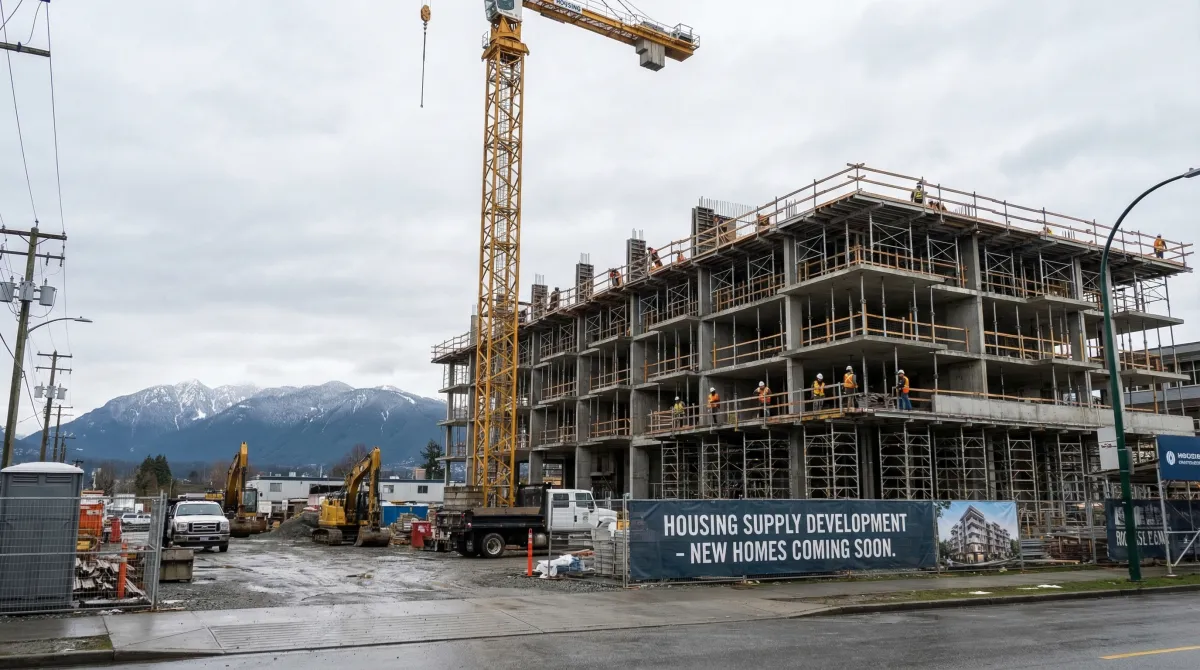
Here is the one genuinely developer-friendly change in the budget. The property transfer tax exemption for purpose-built rental housing has been expanded, and it is retroactive to January 1, 2025.
The change allows newly constructed purpose-built rental buildings that have been leased for up to 24 months before their first taxable sale to still qualify for the PTT exemption. Previously, the building needed to be newly constructed and not yet leased.
To qualify, the building must be:
- Newly constructed and non-stratified
- A minimum of four rental apartments
- Operated as monthly (or longer) rentals for at least 10 years
- Leased for no more than 24 months before the first sale is registered
This matters because developers building rental buildings often need to lease them up and operate them for a period before selling to a long-term institutional owner. The old rule penalized that normal business practice. The new rule gives developers a two-year window.
For properties over $3 million in assessed value, qualifying buildings are also exempt from the additional 2% PTT that normally applies on residential property above that threshold.
If you are building or considering a purpose-built rental, this is a meaningful incentive. PTT on a $10 million rental building would normally run in the hundreds of thousands of dollars. The exemption makes a real difference in project economics.
PST Now Applies to Real Estate Professional Services
This one hit the industry sideways. Effective October 1, 2026, PST expands to cover a range of professional services that were previously exempt:
- Architectural services
- Engineering and geoscience services
- Rental property management
- Strata management
- Commercial real estate sales commissions
- Accounting and bookkeeping
For architectural and engineering services, there is a partial break: PST applies to only 30% of the purchase price, making the effective rate about 2.1% instead of the full 7%.
For anyone building a new home, a multiplex, or any development project, this adds to your soft costs. If your architectural and engineering fees total $200,000 on a multiplex project, you are looking at roughly $4,200 in new PST. Not catastrophic, but it adds up alongside everything else in this budget.
Strata management and rental property management fees will carry the full 7% PST. If your strata fees are $400 per month, that is an extra $28 monthly. Over a year, $336. It is not going to bankrupt anyone, but it is another cost being layered onto housing.
The province expects PST expansion on professional services to generate $261 million in 2026/27, rising to $563 million by 2028/29.
What Multiplex Developers Need to Know
If you are exploring a multiplex build on your lot or selling land to a developer, this budget affects your project economics in three ways.
School tax on development land. The additional school tax applies to vacant land assessed above $3 million. Many west-side lots in Vancouver already clear that threshold. If you are holding land while getting permits and building, you are paying the higher school tax rate for every year of the process. BCREA specifically called this out, arguing that higher taxation rates on development lands will increase costs passed to buyers.
PST on professional services. Your architect, your engineer, and your project accountant will all now be charging PST on their services. On a full multiplex project, that is several thousand dollars in new costs.
Purpose-built rental PTT exemption. If you are building a multiplex specifically as a rental (non-stratified, minimum four units, 10-year rental commitment), the expanded PTT exemption is a genuine benefit. Talk to your lawyer about whether your project qualifies.
My honest read for multiplex developers: these are incremental costs, not project-killers. The fundamentals of multiplex economics in Vancouver remain strong. Land values, rental income, and the ongoing rezoning opportunity under Bill 44 have not changed. But margins are tighter, and this budget did not make them looser.
The Industry Reaction
BCREA’s Chief Economist Brendon Ogmundson was blunt in the association’s February 18 press release: “There is unfortunately not a lot to like from either a macroeconomic or housing perspective in this budget. We understand that the province is in a difficult position and needs to raise revenues, but doing so on the back of an already struggling housing sector will ultimately prove to be self-defeating.”
UBC’s Balanced Supply of Housing scorecard was more nuanced. They gave the government credit for strengthening the SVT and maintaining the 10-year housing strategy, but flagged a $1.4 billion reduction in housing capital spending as a serious concern. They also noted the province’s claim of spending “nearly 5x” the 2016 level on housing is misleading once you adjust for 30% cumulative inflation and 20% population growth since then.
The BC Non-Profit Housing Association was sharper. Their leadership said the budget was “pulling the rug out from under the sector” and that the impacts would be felt for years.
I find myself somewhere in the middle. The SVT increase and school tax hikes are defensible on fairness grounds. But doing it while simultaneously cutting $1.4 billion from housing capital spending sends a contradictory message. You cannot tax housing more and build housing less and expect affordability to improve.
Key Takeaways
- Additional school tax on homes over $3M goes up 50% starting in 2027, adding $500 to $7,000+ annually depending on property value. This hits a lot of regular west-side Vancouver detached homes.
- The SVT rises to 4% for foreign owners and untaxed worldwide earners in 2027. Canadian citizens living in their homes are unaffected.
- Property tax deferment interest jumps from prime minus 2% (simple) to prime plus 2% (compound) for 2026 and beyond. Seniors and families relying on this program should review whether it still makes financial sense.
- Purpose-built rental developers get an expanded PTT exemption, retroactive to January 2025, giving a 24-month lease-up window before first sale.
- PST now applies to architectural, engineering, strata management, and rental management services starting October 2026, adding to development soft costs and ongoing housing expenses.
Frequently Asked Questions
How much more will I pay in school tax on my Vancouver home in 2027?
It depends on your assessed value. If your home is assessed at $3.5 million, you will pay about $500 more per year in additional school tax. At $5 million, expect roughly $3,000 more. At $7 million, about $7,000 more. The tax applies to the assessed value above $3 million, at rates of 0.3% ($3M-$4M) and 0.6% (above $4M). These rates take effect for the 2027 tax year.
Does the speculation and vacancy tax affect me if I live in my home?
No. If you are a Canadian citizen or permanent resident and you live in your home as your principal residence, the SVT does not apply to you at all. The tax targets vacant and underused properties. Even if your property is in a designated SVT area, you simply file your annual declaration confirming you live there or rent it out, and you owe nothing.
Should I stop using the property tax deferment program?
That depends on your situation. The new rate of prime plus 2% compounded monthly (currently about 6.45%) is meaningfully higher than the old simple interest rate. For short-term deferrals, the cost difference is modest. Over 10 or more years, compounding makes a large difference. Compare it against your other options: a home equity line of credit, reverse mortgage, or simply paying the tax. Talk to your financial advisor.
How does this budget affect multiplex development costs?
The budget adds incremental costs through three channels: higher school tax on development land assessed above $3M, new PST on architectural and engineering services (effective rate about 2.1%), and new PST on accounting services. On a typical multiplex project, expect several thousand dollars in new costs. These are not project-killing amounts, but they tighten margins that were already being squeezed by construction costs and permitting timelines.
Does the PTT exemption for rental buildings apply to multiplexes?
Potentially, but only if you structure the project specifically as a purpose-built rental. The building must be non-stratified, contain a minimum of four apartments, and be committed to rental use for at least 10 years. Most owner-occupied multiplexes where units are individually titled would not qualify. If you are building a four-plus unit rental building and plan to hold or sell to an institutional buyer, this exemption can save significant PTT costs. Consult a real estate lawyer about your specific project structure.
Sources
- Lawson Lundell - BC Budget 2026: Real Estate Services, Ownership, Investment and Development Highlights
- PwC Canada - Tax Insights: 2026 British Columbia Budget Tax Highlights
- BCREA - BC Real Estate Association Disappointed by Housing Tax Increases in 2026 Provincial Budget
- UBC Balanced Supply of Housing - BC Budget 2026: A Housing Scorecard
- BC Government - Speculation and Vacancy Tax Rates
- BC Government - Property Tax Deferment Interest Rates
- BC Budget 2026 Highlights
- Daily Hive - BC Government Hikes School Property Tax, Changes Tax Deferment Rules
Data sourced March 2026. Tax rules and rates may change. Consult a qualified tax professional before making financial decisions based on this information.
Want to Talk About How This Affects Your Property?
Budget documents are dense, and the real impact depends on what you own, where you own it, and what your plans are. I have been helping Vancouver homeowners navigate tax and policy changes for 20 years, and the conversation is always more productive when we can look at your specific situation.
Whether you are weighing the cost of holding a west-side detached home, exploring a multiplex conversion, or figuring out what the deferment changes mean for your retirement plan, I am happy to walk through the numbers with you.
Contact Greyden Douglas directly at (604) 218-2289 or book a call to discuss your Vancouver real estate goals.
Related Vancouver real estate pages
Continue with local service pages, neighbourhood guides, and actionable resources related to this topic.