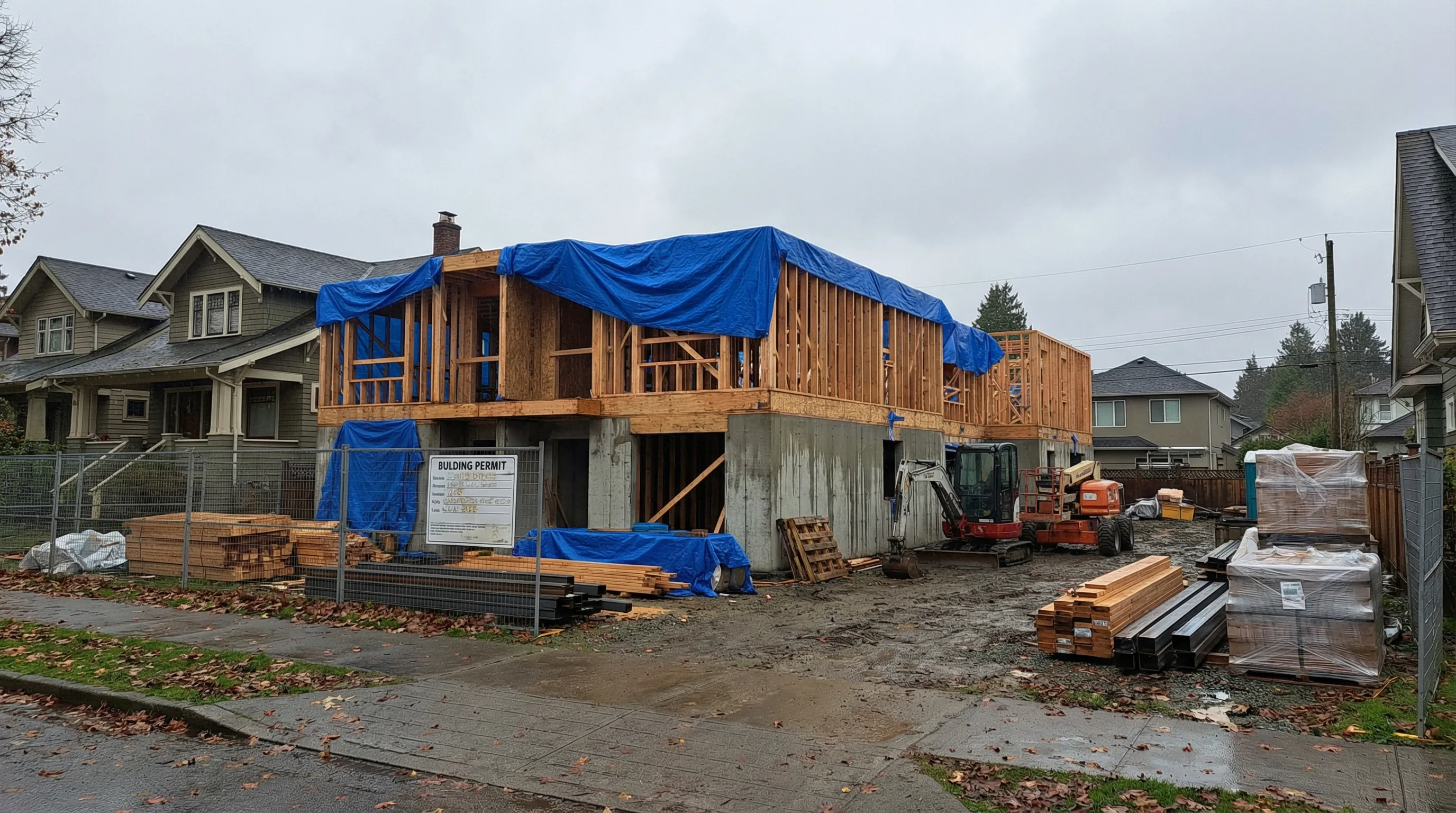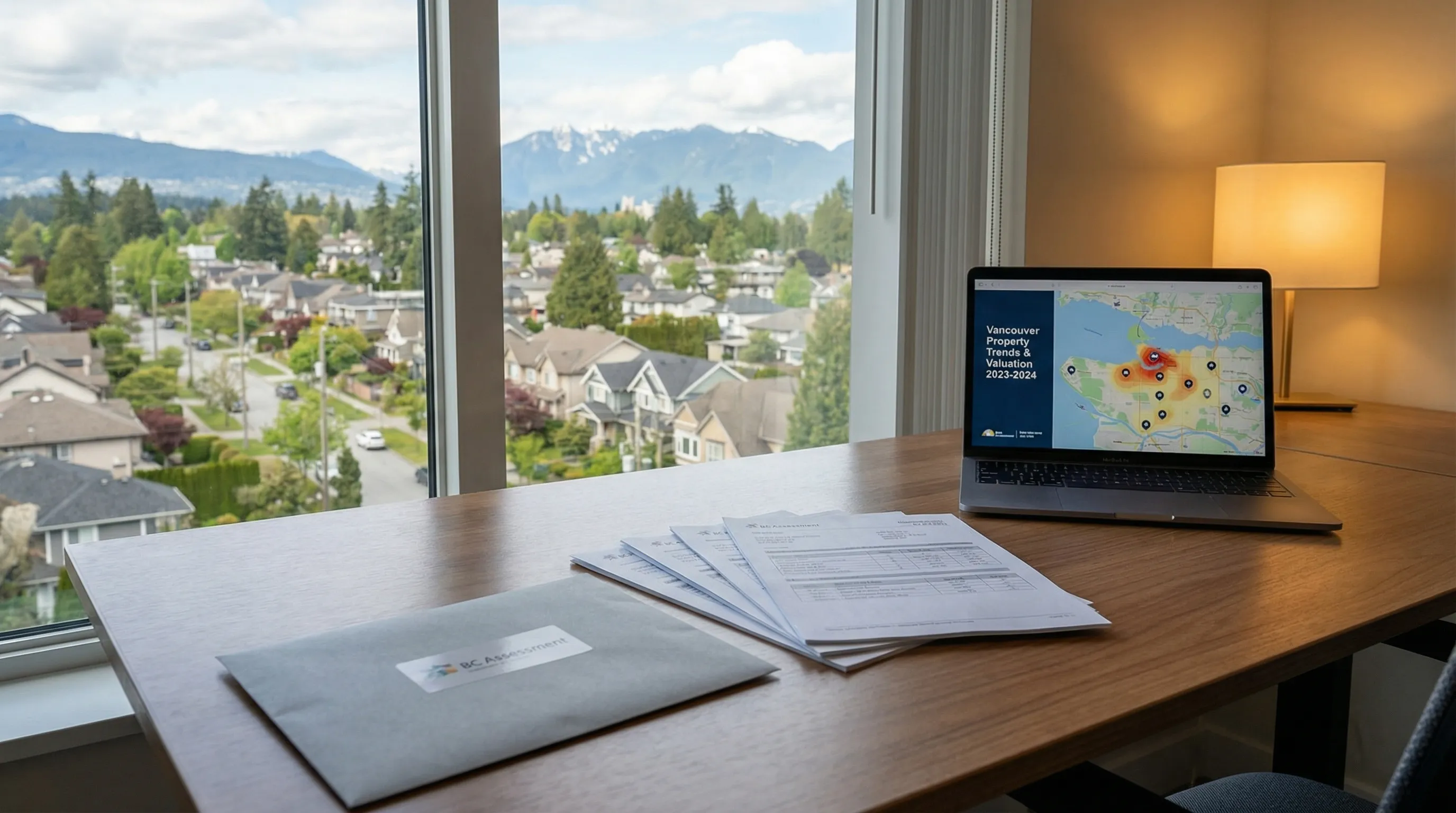
Development cost levies, permit fees, and carrying costs add up to over $200,000 before construction even begins. As missing middle housing starts drop 56% from 2018 levels, here's where the money actually goes—and why 16 Metro mayors are demanding change.
Branden and Sylvie Kotyk thought they’d done everything right. The Mount Pleasant couple owned a lot that checked every box for multiplex development: good size, lane access, established neighbourhood. When Bill 44 passed, they saw an opportunity to build wealth while adding housing to their community.
Then they tallied the fees.
Development Cost Levies. Permit fees. Utility connection charges. Engineering reviews. Project management during a permit process that stretched past a year. By the time they had approvals in hand, they’d spent over $200,000—and they hadn’t poured a single foundation.
Their story isn’t unusual. It’s becoming the norm. And it helps explain why Vancouver’s missing middle housing starts have plummeted 56% since 2018, even as provincial legislation promised a multiplex boom.
The gap between policy intention and ground-level reality starts with a number: $200,000+. That’s what it actually costs to get a shovel in the ground in Vancouver. Understanding where that money goes—and why it matters—is essential for anyone considering multiplex development.
The True Cost Breakdown
When politicians and housing advocates discuss development costs, they often focus on construction. Build a sixplex for $2.5 million, sell units for $7 million, pocket the difference. The math looks elegant on paper.
Reality is messier. Before construction begins, a homeowner or developer faces a gauntlet of fees, charges, and time-dependent costs that most people never see itemized. Here’s what a typical Vancouver sixplex project actually pays:
Development Cost Levies (DCLs)
DCLs are the biggest single line item. Vancouver charges these fees to fund infrastructure improvements—parks, sewers, roads—that new development supposedly requires.
Current Vancouver DCL rates for residential development:
| Fee Type | Rate | 6-Unit Sixplex (6,300 sq ft) |
|---|---|---|
| Citywide DCL | $236.47/sq ft | $148,976 |
| Area-specific DCL | Varies by location | $0-$15,000 |
| DCL Total | $148,976-$163,976 |
That’s right—before permits, before design, before anything else, a sixplex owes roughly $150,000 in Development Cost Levies alone.
The rates were set in 2023 and haven’t adjusted despite significant market changes. When they were calculated, housing prices were higher, interest rates were lower, and project economics looked very different than they do today.
Permit and Application Fees
The permit process involves multiple applications, each with its own fee:
| Fee Type | Approximate Cost |
|---|---|
| Development Permit application | $12,500-$18,000 |
| Building Permit application | $8,000-$15,000 |
| Plumbing permit | $2,000-$4,000 |
| Electrical permit | $1,500-$3,000 |
| Plan review fees | $3,000-$6,000 |
| Addressing fee | $500-$1,000 |
| Miscellaneous city fees | $2,000-$5,000 |
| Permit Total | $29,500-$52,000 |
The range depends on project complexity, lot conditions, and how many revisions the city requires. Simple projects at the low end; anything with design challenges, geotechnical issues, or unusual site conditions lands at the high end.
Utility Connections
New multiplexes require upgraded utility connections that single-family services can’t handle. Six dwelling units need more water pressure, more electrical capacity, and separate sewer connections.
| Utility | Approximate Cost |
|---|---|
| Water service upgrade | $8,000-$15,000 |
| Sewer connection | $5,000-$12,000 |
| Electrical service upgrade (BC Hydro) | $10,000-$25,000 |
| Gas service (FortisBC) | $3,000-$8,000 |
| Telecommunications infrastructure | $2,000-$5,000 |
| Utility Total | $28,000-$65,000 |
The electrical upgrade deserves special mention. BC Hydro’s infrastructure wasn’t designed for multiplex density. In some neighbourhoods, transformers need upgrading before a project can proceed—and the costs fall on the developer. The 9 projects halted mid-construction due to overhead power line issues represent the extreme version of this problem, but smaller delays and costs affect many more.
Soft Costs Before Construction
Beyond city fees and utilities, projects incur professional service costs:
| Service | Approximate Cost |
|---|---|
| Architectural design | $80,000-$150,000 |
| Structural engineering | $15,000-$30,000 |
| Geotechnical report | $5,000-$12,000 |
| Survey and legal | $8,000-$15,000 |
| Energy modelling | $3,000-$8,000 |
| Project management (pre-construction) | $15,000-$35,000 |
| Legal fees | $5,000-$15,000 |
| Soft Cost Total | $131,000-$265,000 |
Not all of these are fees payable to the city. But they’re all real costs that must be paid before construction begins. The homeowner or developer writes these checks regardless of whether the project ultimately proceeds.
The Carrying Cost Trap
Here’s the expense that catches people off guard: time costs money.
From permit application to construction start, Vancouver multiplex projects currently average 12-18 months. During that entire period, the property owner is paying:
- Mortgage interest (if financed)
- Property taxes
- Insurance
- Utilities
- Maintenance
- Opportunity cost of capital tied up
For a $3 million property, carrying costs run approximately:
| Expense | Monthly Cost | 15-Month Total |
|---|---|---|
| Mortgage interest (6%) | $15,000 | $225,000 |
| Property taxes | $1,500 | $22,500 |
| Insurance | $400 | $6,000 |
| Utilities and maintenance | $500 | $7,500 |
| Carrying Total | $17,400/month | $261,000 |
If you have a mortgage on the property, you’re paying roughly $17,000 per month while waiting for permits. Even owners with properties free and clear face opportunity costs—that capital could be earning returns elsewhere.
The Complete Picture
Let me add it up for a realistic sixplex scenario:
| Category | Low Estimate | High Estimate |
|---|---|---|
| Development Cost Levies | $148,976 | $163,976 |
| Permits and applications | $29,500 | $52,000 |
| Utility connections | $28,000 | $65,000 |
| Soft costs | $131,000 | $265,000 |
| Carrying costs (15 months) | $150,000 | $261,000 |
| Total Pre-Construction | $487,476 | $806,976 |
Even at the low end, we’re approaching half a million dollars before construction starts. At the high end, you’re over $800,000 in before a foundation is poured.
The $200,000 figure I cited earlier? That’s just the direct fees and charges, excluding soft costs and carrying costs. The true all-in number is far higher.
How Vancouver Compares
Vancouver’s development fees didn’t emerge in a vacuum. Other cities also charge for infrastructure and services. But the magnitude of Vancouver’s fees stands out.
Calgary
Calgary’s recent upzoning repeal made headlines, but before that reversal, their fee structure was dramatically different:
| Fee Type | Vancouver | Calgary |
|---|---|---|
| Development Cost Levy equivalent | $236/sq ft | $85/sq ft |
| Permit timeline | 12-18 months | 4-8 months |
| Utility upgrade costs | $28,000-$65,000 | $15,000-$30,000 |
Calgary’s faster timelines translate to lower carrying costs. Their lower DCL equivalents mean less cash required upfront. A comparable project in Calgary might reach construction start at 40% of Vancouver’s pre-construction cost.
Edmonton
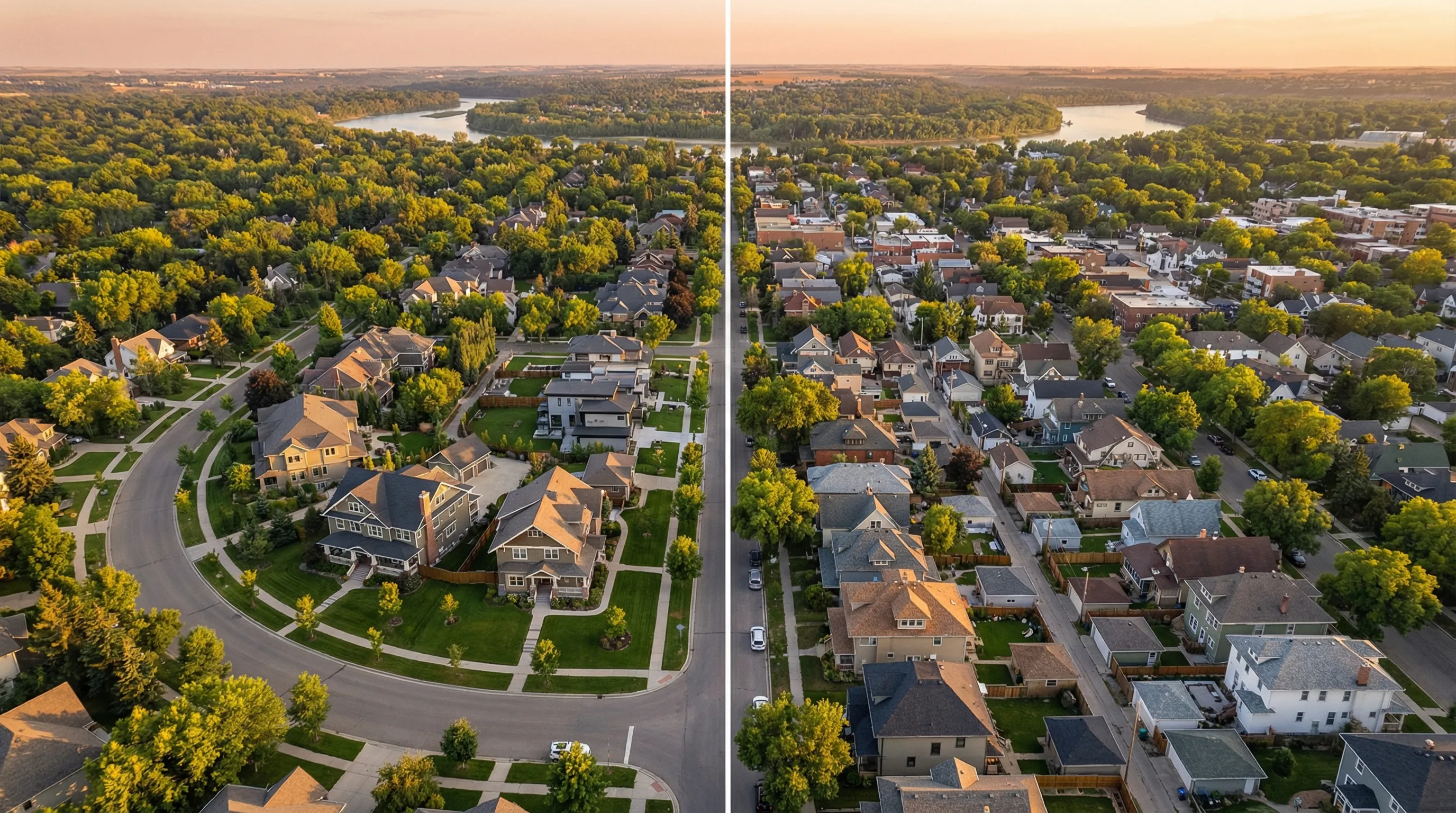
Edmonton has been Canada’s success story for missing middle housing. Their approach differs fundamentally:
| Metric | Vancouver | Edmonton |
|---|---|---|
| Missing middle starts (2024) | Down 56% from 2018 | Up 340% from 2018 |
| Average permit timeline | 14 months | 6 months |
| DCL-equivalent fees | $150,000+ | $45,000 |
Edmonton achieved this through coordinated policy changes: lower fees, streamlined permitting, and infrastructure investment that reduced developer costs. The results speak for themselves—Edmonton is actually building the housing that Vancouver’s policies promised.
The Contradiction
Vancouver’s stated policy goal is more housing. Every council statement, every provincial announcement, every planning document emphasizes the housing crisis and the need for supply.
But the fee structure tells a different story. Fees set during a different market haven’t adjusted. Permit timelines that seemed acceptable during lower interest rates become crushing when carrying costs run $17,000 monthly. Infrastructure charges that made sense for single-family development don’t scale appropriately for multiplex.
The result is a system that says “yes” to density while charging fees that make density economically marginal for many projects.
Who Actually Pays These Fees?
When I present these numbers, people sometimes respond: “Developers can afford it. They’re making millions.”
This misunderstands how development economics work—and who ultimately bears the cost.
It’s Not (Only) Developers
Professional developers do build multiplexes, and they do factor fees into their project budgets. But here’s the mechanism: fees reduce what developers can pay for land.
Remember the residual land value formula:
Land Value = Revenue − Construction − Soft Costs − Fees − Profit
When fees increase by $100,000, land value decreases by $100,000. The developer’s profit margin stays constant. The homeowner receives $100,000 less for their property.
So when Vancouver charges $150,000 in DCLs, that’s $150,000 that doesn’t go to the homeowner selling their lot. It’s a transfer from the homeowner to the city, mediated through the developer’s math.
Homeowner-Developers Get Hit Hardest
Many people exploring multiplex development aren’t professional developers—they’re homeowners looking to build on their own land.
For these homeowner-developers, fees aren’t theoretical deductions from land value. They’re cash outlays that must be paid from savings or borrowed against the property. $200,000+ in pre-construction costs is a barrier that most middle-class homeowners simply can’t clear.
The irony is that Bill 44 was partly intended to enable homeowners to participate in development. But the fee structure ensures that only well-capitalized professionals—or homeowners with substantial liquid assets—can actually afford to build.
Buyers Pay Eventually
Ultimately, all development costs are passed through to end buyers. Fees that increase development costs by $200,000 translate to higher unit prices by roughly that amount (plus developer margin and financing costs on the additional capital).
A $1.3 million multiplex unit includes roughly $35,000-$45,000 in embedded DCLs, permits, and utility charges. That’s money the buyer borrows and pays interest on for the life of their mortgage.
Vancouver’s fees don’t make housing more affordable. They make it more expensive—while generating revenue for the city.
What 16 Mayors Are Saying
The pushback against current fee structures is building momentum.
In late 2025, 16 Metro Vancouver mayors signed a joint letter to the provincial government calling for changes to Bill 44 implementation. While design standards got the headlines, fee structures were a significant concern.
The mayors’ specific requests included:
- Fee review tied to market conditions: DCLs set in 2023 don’t reflect 2026 economics
- Phased fee payment: Allow fees to be paid at occupancy rather than permit issuance
- Waiver programs for specific housing types: Reduce fees for rental, affordable, or small-scale projects
- Infrastructure cost-sharing: Province should fund utility upgrades that enable density
These aren’t radical proposals. They’re pragmatic adjustments that other jurisdictions have implemented successfully.
The BCAN Coalition Position
The British Columbia Alliance of Neighbourhoods (BCAN), representing residents across the province, has also called for fee reform—though from a different angle.
BCAN’s position emphasizes that high fees ensure only expensive market housing gets built. If the goal is affordability, charging $150,000+ in DCLs before construction starts guarantees the resulting units will be priced to recover those costs.
Their proposal: significantly reduce fees for rental housing, below-market housing, and smaller-scale projects. Shift infrastructure funding to general revenue rather than per-unit charges.
What Reform Could Look Like
If policymakers genuinely want to increase housing supply, several reform paths exist:
Option 1: Fee Reduction
The most direct approach: reduce DCLs and permit fees to levels comparable to other major Canadian cities.
A 50% reduction in DCLs would save roughly $75,000 per sixplex project. That’s money that could reduce unit prices, increase land values (benefiting homeowners), or improve project feasibility for marginal sites.
The concern: reduced DCL revenue means less funding for infrastructure. But if the alternative is projects that don’t get built, the city collects zero DCLs anyway.
Option 2: Deferred Payment
Allow DCLs to be paid at occupancy rather than permit issuance.
This doesn’t reduce total fees but dramatically improves project cash flow. A homeowner-developer doesn’t need $150,000 cash upfront—they can finance the fees into construction lending and pay at completion when sales revenue arrives.
Calgary and other cities have implemented deferred payment successfully. Administrative complexity is manageable.
Option 3: Tiered Fees
Charge different fees based on project characteristics:
- Rental projects: Reduced fees (housing stays as rental supply)
- Below-market units: Fee waivers for affordable housing
- Small-scale projects (3-4 units): Lower fees acknowledging tighter margins
- Larger projects (5-6 units): Standard fees
This approach targets incentives toward housing types that address affordability rather than subsidizing all development equally.
Option 4: Streamlined Timelines
Every month of delay costs $15,000-$20,000 in carrying costs. Cutting permit timelines from 15 months to 8 months would save $100,000+ per project—without any fee reduction.
Vancouver has announced streamlining initiatives, and data shows improvement. But the 50% reduction in timelines that the city announced translates to cutting from, say, 18 months to 9 months—still long enough to cost six figures in carrying costs.
Real impact requires hitting 4-6 month timelines consistently, as Edmonton has demonstrated is possible.
What This Means for Your Project
If you’re considering multiplex development in Vancouver, fees are a fundamental consideration in your feasibility analysis.
Know Your Numbers Before Committing
Before signing any agreements—whether with architects, builders, or land purchase contracts—get detailed fee estimates for your specific project:
- Confirm DCL rates for your neighbourhood and project type
- Estimate permit fees based on project size and complexity
- Get utility quotes for required service upgrades
- Project realistic timelines and calculate carrying costs
A $50,000 error in fee estimation can flip a project from profitable to underwater. Don’t rely on generic numbers—get specifics for your site.
Factor Fees Into Land Value
If you’re buying a lot for development, fees directly affect what you can pay. A site that looks attractive at $3 million might be overpriced once you add $500,000 in pre-construction costs.
Experienced developers build fee schedules into their acquisition math automatically. Homeowners entering the development space need to adopt the same discipline.
Consider Timing and Policy Direction
Fee structures can change. The current political conversation suggests pressure toward reform. If significant fee reductions or streamlining occur in the next 12-24 months, projects that look marginal today might become attractive.
This doesn’t mean waiting indefinitely—but it does mean staying informed about policy developments and being ready to move if conditions improve.
Rental vs. Strata Economics
Current fee structures hit rental and strata projects similarly. But policy reform is more likely to favour rental development, given provincial affordability priorities.
If your project could work as either rental or strata, understand how potential fee changes might affect each path. Building flexibility into your planning could pay off.
The Bigger Question
Vancouver needs housing. Everyone agrees on this. The question is whether current policy actually delivers it.
When pre-construction costs exceed $500,000 and timelines stretch past a year, many potential projects simply don’t happen. Homeowners who might develop their lots decide it’s not worth the complexity. Builders who might expand in Vancouver focus on Edmonton or Calgary instead. Projects that pencil in other cities fail the math here.
The fees aren’t evil—they fund legitimate infrastructure needs. But their current levels, combined with extended timelines, create a system that promises housing while making it difficult to build.
Every housing unit that doesn’t get built because fees made it infeasible is a unit that’s not available for someone who needs it. Every homeowner who decides against development is a potential sixplex that never exists.
The $200,000 question isn’t really about money. It’s about whether Vancouver’s policies match its stated priorities. Right now, the gap between rhetoric and reality is measured in six figures—and in the housing that isn’t getting built.
Frequently Asked Questions
Are DCLs negotiable?
No. DCLs are set by bylaw and apply uniformly to all projects of a given type and location. There’s no negotiation or appeal process for the rates themselves. Some project types (purpose-built rental, for example) may qualify for reduced rates, but standard strata development pays full freight.
Can fees be financed into construction loans?
Typically, DCLs must be paid before building permits issue. Construction financing doesn’t activate until permits are in hand. This creates a cash flow gap that requires upfront capital or bridge financing at unfavourable rates.
Some lenders offer pre-development financing that covers fees, but rates are higher than construction loans and terms are less favourable.
Do other Metro Vancouver cities have lower fees?
It varies. Burnaby, Richmond, and other municipalities have their own DCL structures, often lower than Vancouver’s. However, development potential also varies—what you can build by right in Vancouver may require rezoning elsewhere.
The calculus involves comparing fees, development rights, land costs, and end values across jurisdictions. Some projects make more sense outside Vancouver; others don’t.
Is there any relief for homeowner-developers?
Currently, no. Vancouver doesn’t distinguish between professional developers and homeowners building on their own lots. Both pay identical fees regardless of experience, scale, or financial capacity.
Some advocates have proposed homeowner exemptions or reduced fees for first-time developers, but nothing has been implemented.
Will fees decrease if the market stays soft?
Possibly, but not automatically. DCLs require council action to change. Fees set during better market conditions tend to persist because reducing them requires affirmative political decision-making.
If housing starts continue declining, political pressure for reform may build. But there’s no automatic adjustment mechanism tied to market conditions.
Making Informed Decisions
Understanding Vancouver’s fee structure is essential for anyone considering multiplex development. The headline numbers—$200,000+ in pre-construction costs—are just the starting point. Your specific project will have specific costs that depend on location, scale, complexity, and timing.
I help Vancouver homeowners understand these economics clearly before they commit to development paths. That means detailed fee analysis, realistic timeline projections, and honest assessment of whether projects make financial sense.
If you’re exploring multiplex options, let’s start with the numbers. Understanding the $200,000 question is the foundation for every decision that follows.
Contact Greyden Douglas directly at (604) 218-2289 or book a call to discuss your Vancouver real estate goals.