Summary: Data-driven analysis of the geographic disparity in Vancouver multiplex development under Bill 44, showing West Side neighbourhoods receiving approximately 3x more sixplex applications than East Vancouver. Explores contributing factors including lot width requirements, land economics, builder preferences, and discusses policy implications for housing equity.
An analysis of multiplex permit data reveals a stark geographic disparity in Bill 44 development. West side neighbourhoods are seeing three times more sixplex applications than the east side—and the reasons go deeper than lot sizes.
Last week, I had coffee with a developer I’ve worked with for years. He builds quality multiplexes—the kind that actually win neighbourhood approval and sell well. We were talking about his pipeline for 2026, and I asked what surprised me: “Where are you focusing your acquisitions?”
His answer was immediate. “West of Main Street. Almost exclusively.”
When I pressed him on why, he pulled out his phone and showed me his tracking spreadsheet. Of the 23 sites he’d evaluated in the past six months, only 4 were east of Main. And of those four, he’d passed on all of them.
“The math just works better on the west side,” he said. “Better lot widths, better sale prices, more predictable margins.”
That conversation sent me down a rabbit hole. I started pulling permit data, analysing lot dimensions across neighbourhoods, and talking to other builders. What emerged is a picture of Bill 44 that nobody’s really discussed: a geographic divide that’s concentrating multiplex development—and its benefits—in Vancouver’s wealthiest areas.
The Numbers Tell a Story
When you dig into Vancouver’s permit data, the disparity is striking.
Looking at sixplex applications specifically—the building type that maximizes units under R1-1 zoning—West Side neighbourhoods are outpacing East Van by roughly 3 to 1. This ratio holds whether you count applications, issued permits, or projects under construction.
| Neighbourhood | Sixplex Applications | Building Permits Issued |
|---|---|---|
| Dunbar-Southlands | 47 | 21 |
| Kerrisdale | 38 | 18 |
| Point Grey | 34 | 15 |
| Shaughnessy | 29 | 12 |
| Kitsilano | 42 | 19 |
| West Side Total | 190 | 85 |
| Hastings-Sunrise | 21 | 9 |
| Renfrew-Collingwood | 18 | 7 |
| Kensington-Cedar Cottage | 24 | 11 |
| Killarney | 12 | 5 |
| Victoria-Fraserview | 15 | 6 |
| East Van Total | 90 | 38 |
The gap becomes even more pronounced when you look at fourplexes—the maximum unit count available on smaller lots. East Vancouver has more fourplex applications than the west side. But fourplexes generate less revenue, require similar soft costs, and produce thinner margins. They’re often the consolation prize when a sixplex isn’t feasible.
The 49.5-Foot Problem
The single biggest factor driving this divide is lot width.
Under R1-1 zoning, a lot needs to be at least 49.5 feet wide to qualify for maximum density—six strata units or eight rental units. Drop below that threshold, and your maximum drops to four or five units.
Here’s where Vancouver’s development history creates today’s inequality.
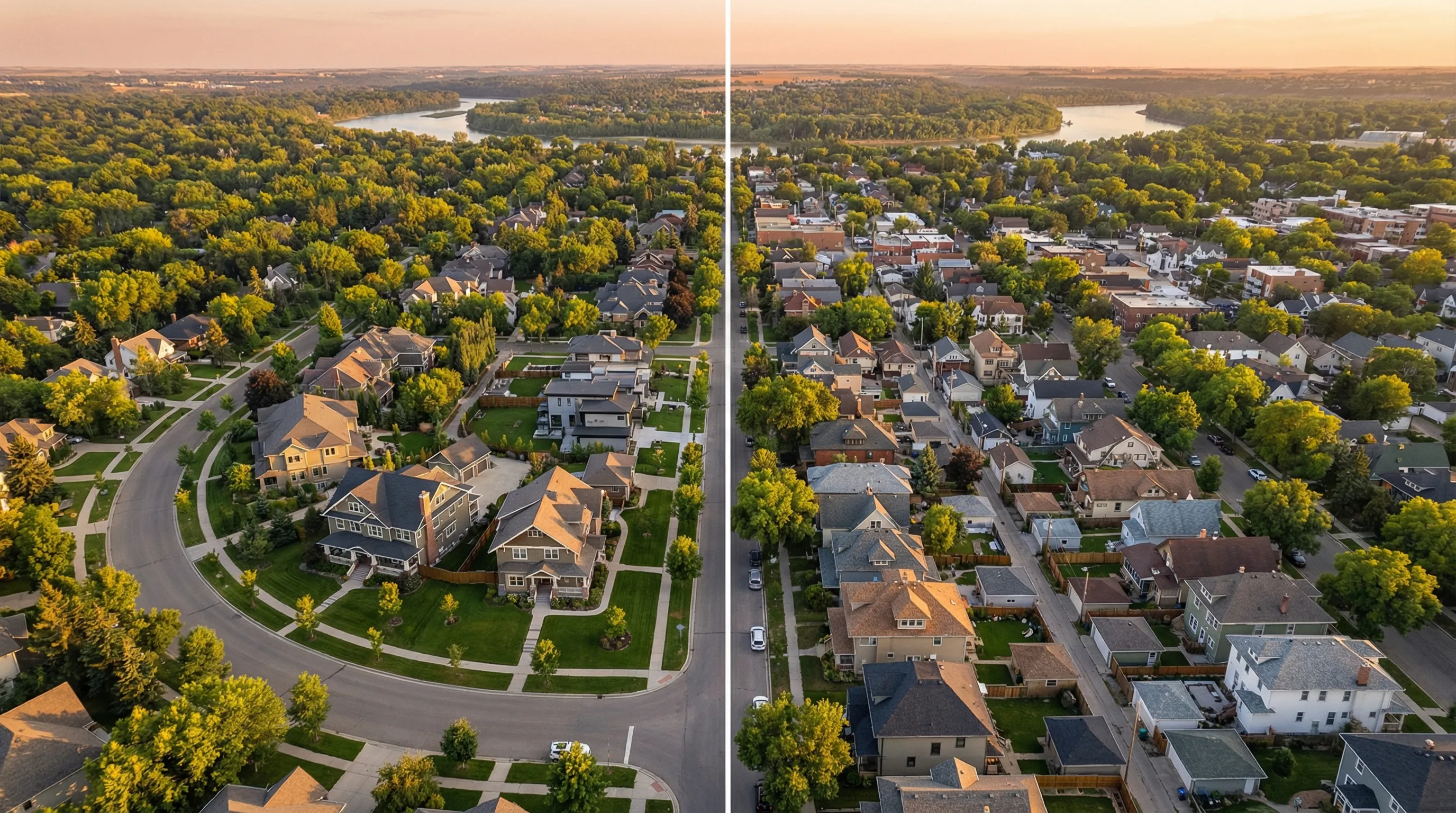
When Vancouver’s west side was subdivided in the early 20th century, developers platted generous lots. The standard was 50 feet by 120 feet—6,000 square feet with ample frontage. These lots were marketed to middle-class professionals building family homes.
East Vancouver was subdivided for working-class housing. Lots were narrower: 33 feet was common, sometimes 40 feet. The same 4,000-square-foot area, but in a long, narrow configuration that worked fine for single-family homes but creates constraints for multiplexes.
The numbers show this clearly:
| Neighbourhood | Average Lot Width | % Qualifying for 6 Units |
|---|---|---|
| Dunbar | 51.2 ft | 78% |
| Kerrisdale | 50.8 ft | 74% |
| Point Grey | 52.1 ft | 81% |
| Hastings-Sunrise | 38.4 ft | 31% |
| Renfrew-Collingwood | 36.2 ft | 24% |
| Kensington-Cedar Cottage | 37.8 ft | 28% |
A homeowner in Dunbar has roughly a 3-in-4 chance of their lot qualifying for maximum density. A homeowner in Renfrew-Collingwood has less than a 1-in-4 chance.
This isn’t something Bill 44 created—it’s a legacy of how the city was built over a century ago. But Bill 44’s regulations turn that legacy into a wealth multiplier.
The Economic Gap Widens
Lot width is only part of the equation. The economics of completed units diverge even further.
Finished multiplex units in West Side neighbourhoods sell for significantly more than equivalent units in East Van. Recent sales data shows:
| Neighbourhood | Average Sale Price/Sq Ft | 1,000 sq ft Unit Value |
|---|---|---|
| Kerrisdale | $1,520 | $1,520,000 |
| Dunbar | $1,480 | $1,480,000 |
| Point Grey | $1,610 | $1,610,000 |
| Hastings-Sunrise | $1,080 | $1,080,000 |
| Renfrew-Collingwood | $1,020 | $1,020,000 |
| Kensington-Cedar Cottage | $1,050 | $1,050,000 |
A developer building the same quality product faces a 40-50% revenue premium on the west side. But construction costs don’t scale the same way. Labour, materials, permits, and fees are roughly equivalent regardless of neighbourhood. The difference flows straight to land value and profit margin.
Let me run through the math on two hypothetical projects:
West Side (Kerrisdale, 50’ x 120’ lot):
- 6 units × 1,050 sq ft avg = 6,300 sellable sq ft
- Revenue at $1,520/sq ft = $9,576,000
- Construction costs at $450/sq ft = $2,835,000
- Soft costs (20%) = $567,000
- Developer profit (15%) = $1,797,000
- Residual land value: $4,377,000
East Van (Hastings-Sunrise, 50’ x 120’ lot):
- 6 units × 1,050 sq ft avg = 6,300 sellable sq ft
- Revenue at $1,080/sq ft = $6,804,000
- Construction costs at $450/sq ft = $2,835,000
- Soft costs (20%) = $567,000
- Developer profit (15%) = $1,276,000
- Residual land value: $2,126,000
Same lot size. Same construction. Same timeline. But the West Side lot supports over twice the land value.
Now consider that most East Van lots don’t even qualify for six units. A 33’ × 120’ lot might max out at four units, further compressing the economics.
Why Builders Avoid East Van
I talked to six different multiplex builders for this analysis. Their reasoning was consistent.
Capital efficiency: “I’ve got limited capital and limited bandwidth,” one told me. “If I can do three projects on the west side that generate the same return as six projects in East Van, why would I spread myself thin?”
Predictability: West Side buyers tend to be more familiar with the product type. They’ve seen multiplexes in their travels, they understand strata ownership, and they’re often buying for investment alongside occupancy. East Van’s buyer pool is less predictable.
Competition: Ironically, the premium neighbourhoods have less competition for land right now. “Everyone assumes they can’t afford west side lots,” another builder said. “But the numbers actually work better there. You’ve got fewer buyers competing for sites that pencil better.”
Exit risk: If the market softens, West Side units have more downside protection. Buyers at $1.5 million are often more resilient than buyers at $1.0 million—more equity, more stable income, more ability to absorb a rate increase.
None of this is irrational. Builders are responding to incentives exactly as economic theory predicts. The problem is that those incentives channel development away from areas that could arguably benefit most from new housing options.
The Equity Question
This brings us to the uncomfortable conversation about who Bill 44 is actually serving.
The stated goals of provincial housing policy include improving affordability and increasing housing options across all neighbourhoods. If multiplex development concentrates in wealthy areas, does it achieve those goals?
The optimist’s view: Any new housing helps. West Side multiplexes add supply to the regional market. Some new units will be more affordable than the single-family homes they replace—a $1.5 million strata unit is more accessible than a $4 million house. And market dynamics eventually spread: as West Side density increases, pressure on East Van housing may ease.
The skeptic’s view: Bill 44 is a wealth transfer mechanism that primarily benefits homeowners who already won the real estate lottery. West Side lot owners capture development premiums of $2-4 million while their homes are demolished and replaced with market-rate housing. East Van homeowners get modest premiums (or none, if their lots don’t qualify). The housing that gets built is expensive by any standard—$1.0 to $1.6 million isn’t “affordable” to median-income households.
The realist’s view: Policy outcomes rarely match stated intentions. Bill 44 was designed to increase density uniformly, but interacted with Vancouver’s physical reality—lot sizes established a century ago—to produce uneven results. This doesn’t make the policy wrong, but it should inform how we evaluate its success.
What This Means If You Own Property
If you’re a Vancouver homeowner considering multiplex development, this analysis has practical implications.
East Van Homeowners
Your lot may have more development value than you realize—even if it doesn’t qualify for maximum density.
A 33-foot lot supporting four units can still generate significant premium over single-family value. The gap to West Side returns is real, but so is the gap between development value and residential value.
More importantly, you face less competition. Builders focused on West Side sites may overlook opportunities in Hastings-Sunrise or Kensington. A savvy homeowner working with the right realtor can still find serious buyers.
Some specific opportunities I’m seeing in East Van:
- Corner lots: A 33’ × 120’ corner lot may qualify for more units than an interior lot of the same dimensions, due to setback calculations
- Lane access lots: Parking and unit entry are easier to solve with rear lanes, making these sites more attractive despite narrower frontage
- Assemblies: Two adjacent 33’ lots create a 66’ × 120’ site that unlocks maximum density. If you know your neighbour is also considering selling, the combined value exceeds separate sales
West Side Homeowners
You’re sitting on high-value development sites, but you’re also facing more sophisticated buyers.
Developers targeting West Side lots have done their math. They know residual land values, they understand your alternatives, and they’ve likely approached multiple owners on your block.
This doesn’t mean you lack leverage—it means you need to understand your position. A well-marketed property with genuine competition can still extract premium pricing. But accepting the first offer from a cold-calling developer is almost certainly leaving money behind.
The premium you capture depends on demonstrating development potential and generating buyer competition, not just waiting for offers.
The Timing Question
The geographic divide in applications doesn’t necessarily mean East Van development will remain depressed.
As West Side opportunities become scarcer and pricier, some builders will shift focus. Early movers to East Van may face less competition for sites and find homeowners more willing to engage.
I’m already seeing this in preliminary conversations. Builders who wouldn’t consider East Van in 2024 are starting to evaluate sites in 2026. The timeline for this shift is uncertain, but the direction seems clear.
Policy Implications Worth Watching
Several policy discussions could affect this divide going forward.
Lot width requirements: Some housing advocates have proposed reducing the threshold for maximum density. If a 40-foot lot could support six units instead of four, East Van’s economics would improve substantially. The City hasn’t signaled movement on this, but it’s technically possible under provincial legislation.
Incentive programs: Targeted incentives for development in lower-income neighbourhoods could offset the economic gap. Fee reductions, expedited permitting, or density bonuses for specific areas are all tools other cities have used. Vancouver hasn’t proposed anything of this nature, but the conversation exists.
Design standards: Ironically, stricter design standards could help East Van. If West Side projects face more scrutiny, costs rise and some marginal projects become infeasible. Builders might then look east for simpler regulatory environments.
Rental requirements: If future regulations require rental tenure rather than strata ownership, the economics shift significantly. Rental cap rates don’t show the same geographic variance as sale prices. A rental sixplex in East Van and one in Kerrisdale might cash flow similarly, even if sale values diverge.
None of these changes are imminent. But policy environments evolve, and the current divide isn’t necessarily permanent.
Looking at the Longer Arc
When I started researching this piece, I expected to find what I found: West Side lots are bigger, sell for more, and attract more builder interest. The three-to-one ratio was striking but not surprising once I understood the underlying factors.
What I didn’t expect was my own reaction.
I’ve been selling Vancouver real estate for almost two decades. I’ve worked with buyers and sellers across the city. I understand that markets aren’t fair—they’re markets. Prices reflect scarcity, demand, and economic fundamentals, not moral judgments about who deserves what.
But there’s something uncomfortable about a housing policy designed to increase options that, in practice, concentrates benefits in already-wealthy areas.
The homeowner in Dunbar with a 50-foot lot has multiple options: sell to a developer for a $4 million premium, partner with a builder to retain units, or watch property values rise as neighbours develop. The homeowner in Renfrew with a 33-foot lot has fewer options, smaller premiums, and less upside.
Both bought homes in Vancouver. Both pay property taxes. Both deserve to benefit from policies intended to improve housing outcomes. But their outcomes diverge because of lot dimensions established when neither was alive.
I don’t have a clean answer to this. Policies have second-order effects that often contradict first-order intentions. Bill 44 increased development potential across Vancouver, which is genuinely positive. That the increase varies by neighbourhood reflects physical reality, not policy failure.
But we should at least be honest about what’s happening. The multiplex boom isn’t evenly distributed. The wealth creation isn’t either. And if we want policies that serve all of Vancouver, we need to acknowledge where current policies fall short.
Frequently Asked Questions
Does my East Van lot still have development potential?
Almost certainly yes, though possibly less than a West Side equivalent. Even a lot that only qualifies for four units can support development premiums over single-family value. The key is understanding your specific lot’s constraints and marketing to appropriate buyers.
Why don’t developers just build more fourplexes in East Van?
Some do. But fourplexes have thinner margins because soft costs (permits, design, project management) don’t scale proportionally with unit count. A sixplex’s soft costs might be 15% higher than a fourplex’s, but revenue is 50% higher. Builders understandably prefer the better ratios.
Will East Van eventually see more multiplex development?
Likely yes. As West Side opportunities become scarcer, builders will look elsewhere. Early movers to East Van will face less competition and may find more motivated sellers. The timing is uncertain, but the economic logic points toward eventual equilibrium.
Should East Van homeowners wait for the market to shift?
It depends on your timeline and circumstances. Waiting might bring more buyer interest, but also more seller competition. If you need to sell within the next year, marketing now to the buyers who are already active makes sense. If you can wait 2-3 years, you might see more options.
Is Bill 44 failing East Vancouver?
That’s a values question more than a market question. Bill 44 increased development potential everywhere—that’s objectively true. That the increase varies by lot characteristics reflects physical constraints, not policy intent. Whether that variation constitutes failure depends on what you think policy should achieve.
Getting Clarity on Your Specific Situation
The geographic divide in multiplex development creates different opportunities and challenges depending on where you own property. Understanding your lot’s specific potential—unit count, development economics, realistic land value—is the foundation for any decision.
I provide complimentary consultations for Vancouver homeowners exploring development options. We’ll review your property’s characteristics, discuss market conditions in your neighbourhood, and outline realistic paths forward—whether that’s selling to a developer, partnering on development, or staying put.
Twenty years of Vancouver real estate experience means I understand both sides of this divide. Let’s talk about where your property fits.
Contact Greyden Douglas directly at (604) 218-2289 or book a call to discuss your Vancouver real estate goals.
Related Vancouver real estate pages
Continue with local service pages, neighbourhood guides, and actionable resources related to this topic.