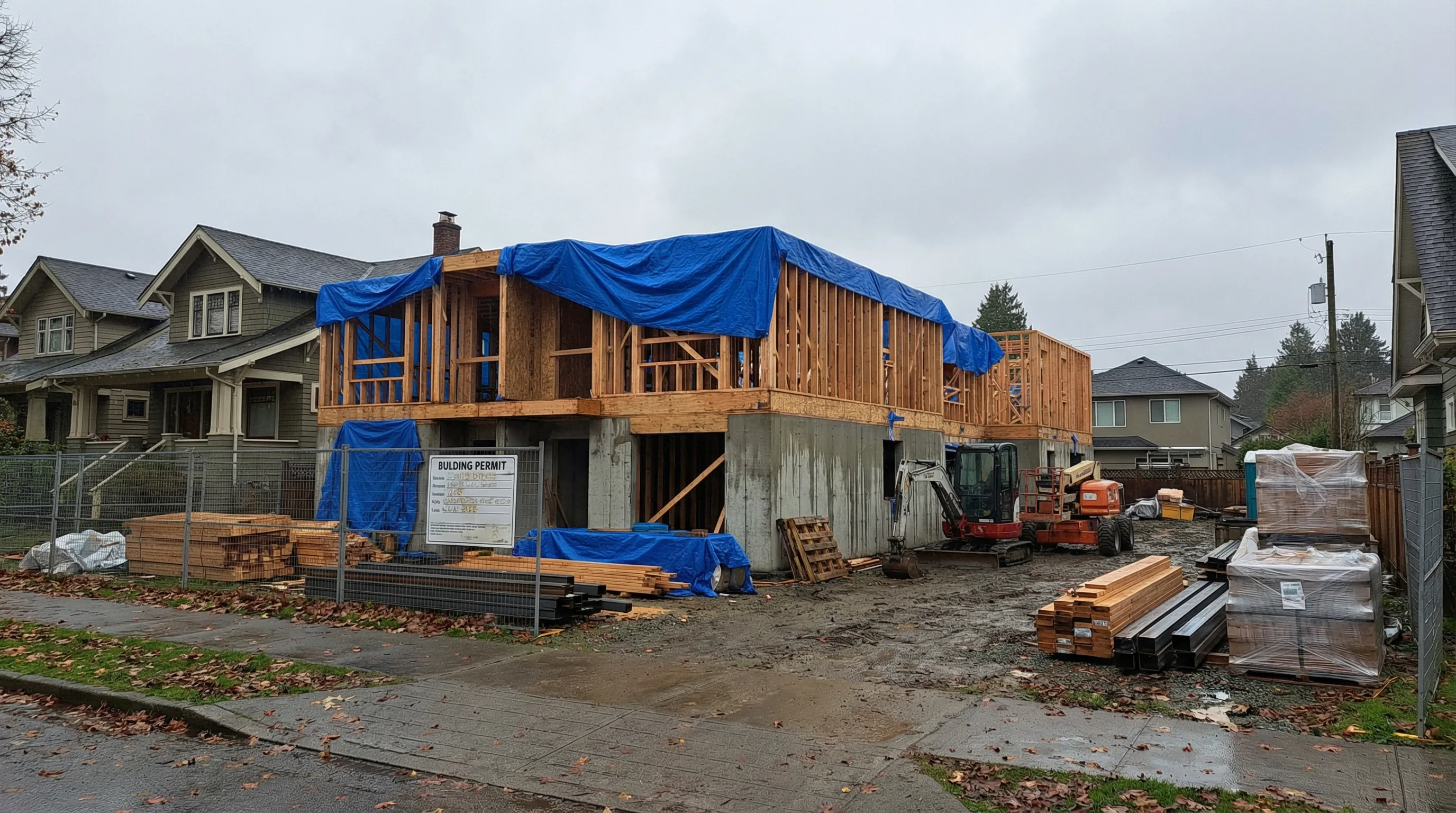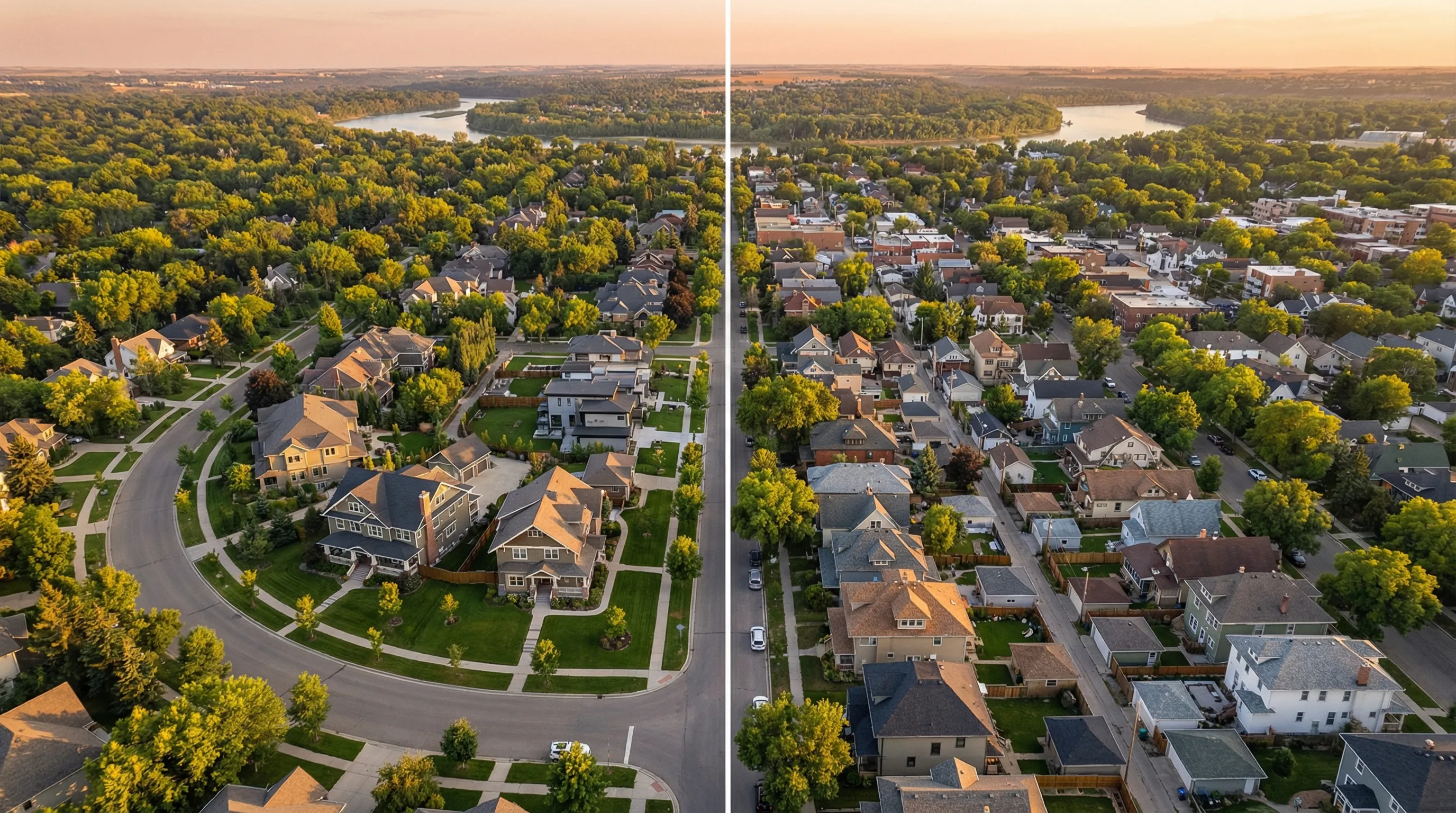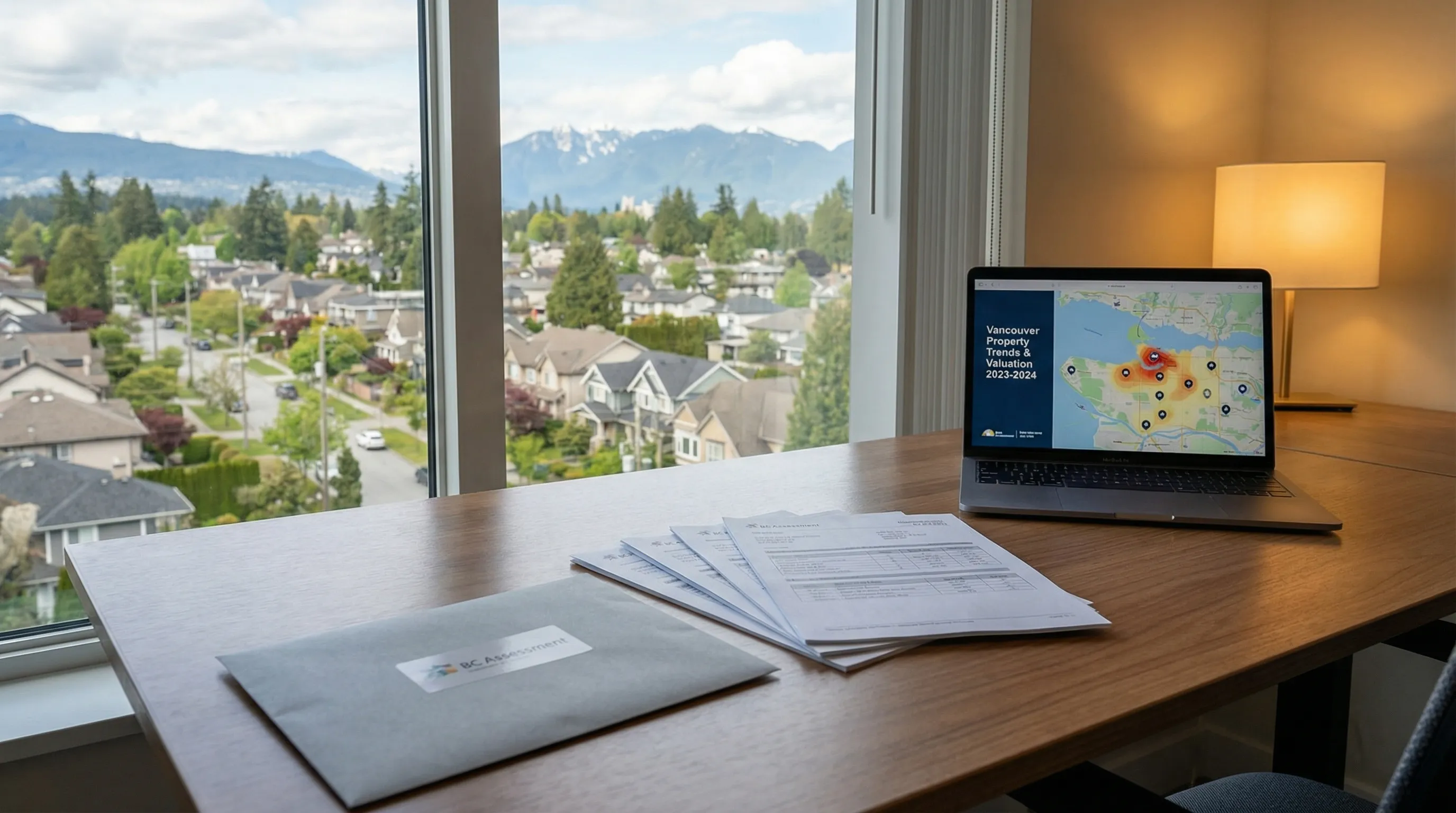
BC Assessment just released 2026 numbers showing Vancouver single-family values down 5% on average. But for multiplex-eligible lots, the picture is more complex—and the deadline to file an assessment complaint is February 2, 2026.
The envelopes arrived in mailboxes across Vancouver this month, and the numbers inside have people talking.
BC Assessment’s 2026 property assessments show Metro Vancouver residential values down across the board. The average Vancouver single-family home assessment dropped 5% from last year—$2,205,000 down to approximately $2,092,000. University Endowment Lands fell 8%. The regional total assessed value declined from $2.01 trillion to $1.92 trillion.
My phone started ringing the morning the numbers were released. “Greyden, my assessment dropped 8%. Does this mean my multiplex potential is gone?”
The short answer: no. Assessment values and development values are different things, calculated differently, serving different purposes.
But the relationship between the two is worth understanding—especially with the February 2, 2026 complaint deadline approaching.
What the 2026 Numbers Actually Show
Let me lay out the data first, then explain what it means.
Metro Vancouver Overview
| Area | 2025 Assessment | 2026 Assessment | Change |
|---|---|---|---|
| Vancouver | $2,205,000 | $2,092,000 | -5.1% |
| Burnaby | $1,815,000 | $1,724,000 | -5.0% |
| Richmond | $1,960,000 | $1,862,000 | -5.0% |
| North Vancouver City | $2,180,000 | $2,050,000 | -6.0% |
| West Vancouver | $3,285,000 | $3,120,000 | -5.0% |
| UEL | $3,800,000 | $3,496,000 | -8.0% |
| Surrey | $1,485,000 | $1,456,000 | -1.9% |
The declines reflect market conditions as of July 1, 2025—the valuation date BC Assessment uses. Sales activity was slow; interest rates remained elevated; buyer sentiment was cautious.
Vancouver Neighbourhood Detail
Within Vancouver, the picture varies:
| Neighbourhood | 2025 Assessment | 2026 Assessment | Change |
|---|---|---|---|
| Point Grey | $3,950,000 | $3,715,000 | -5.9% |
| Shaughnessy | $5,200,000 | $4,888,000 | -6.0% |
| Kerrisdale | $3,380,000 | $3,211,000 | -5.0% |
| Dunbar | $3,150,000 | $2,993,000 | -5.0% |
| Kitsilano | $2,480,000 | $2,381,000 | -4.0% |
| Hastings-Sunrise | $1,720,000 | $1,651,000 | -4.0% |
| Renfrew-Collingwood | $1,590,000 | $1,542,000 | -3.0% |
| Kensington-Cedar Cottage | $1,680,000 | $1,630,000 | -3.0% |
West Side neighbourhoods generally showed larger declines than East Van—consistent with broader market trends where higher-priced segments faced more pressure.
Assessment vs. Development Value: The Critical Distinction
Here’s where confusion enters: your BC Assessment value and your property’s development value are different numbers, determined differently.
How BC Assessment Values Property
BC Assessment values your property based on what they call “actual value”—essentially, the price a willing buyer would pay a willing seller on the valuation date (July 1 of the prior year).
For single-family homes, this means:
- Comparable sales analysis (what similar homes sold for)
- Location, size, condition, and amenities
- Market conditions at the valuation date
Crucially, BC Assessment values your property as it currently exists and is used. A single-family home is assessed as a single-family home, not as a potential multiplex.
How Developers Value Property
Developers use a completely different methodology: residual land value analysis.
Residual land value asks: “What can be built here, what will it sell for, what will it cost to build, and what does that imply the land is worth?”
This analysis considers:
- Maximum buildable density under current zoning
- Expected sale prices for completed units
- Construction and soft costs
- Developer profit requirements
The residual value can be significantly higher than single-family residential value—because it reflects development potential, not current use.
A Concrete Example
Consider a 50’ × 120’ lot in Kitsilano:
BC Assessment (2026): $2,381,000 This reflects: comparable single-family sales in the area, adjusted for lot size and condition.
Developer’s Residual Land Value: $3,800,000 This reflects:
- 6 buildable units at $1,450,000 average = $8,700,000 project value
- Less construction and soft costs: $3,200,000
- Less developer profit (15%): $1,700,000
- Residual land value: $3,800,000
The developer sees $3.8 million in land value where BC Assessment sees $2.4 million. Both calculations are valid—they’re just measuring different things.
What This Means for Your Assessment
Your 2026 assessment dropping 5% doesn’t mean your development potential dropped 5%.
Development potential depends on:
- Zoning (unchanged by assessment)
- Buildable area (unchanged by assessment)
- Construction costs (relatively stable)
- End-unit values (correlated with but not identical to assessment)
If end-unit values dropped proportionally to assessments, development potential would decline somewhat. But new construction multiplex units don’t trade identically to single-family homes. Their value depends on different factors: investor demand, rental yields, condo market conditions.
In practice, development land values have held more stable than single-family assessed values over the past year. The developers I work with haven’t dramatically reduced their acquisition prices just because assessments fell.
Does BC Assessment Consider Development Potential?
This is the technical question that matters for assessment appeals.
BC Assessment is legally required to value property at its highest and best use—the use that would result in the highest value, assuming that use is legally permissible and physically possible.
For multiplex-eligible lots, the highest and best use is arguably development into a multiplex, not continued use as a single-family home.
How BC Assessment Handles This
BC Assessment’s approach has been evolving since Bill 44 passed. Their general position:
-
Existing homes remain assessed as residential: If you’re living in a single-family home, it’s assessed based on single-family comparable sales, not theoretical development value.
-
Vacant land considers development potential: Empty lots are assessed based on development potential because there’s no existing use to value.
-
Market evidence shapes valuation: If single-family buyers are paying premiums for multiplex-eligible lots, those premiums show up in comparable sales analysis—indirectly incorporating development value.
The practical result: most occupied single-family homes are assessed below their development value, because BC Assessment isn’t explicitly running residual value calculations on every lot.
Is This Correct?
Opinions differ. Some appraisers argue that BC Assessment should value all multiplex-eligible lots at development value—that’s the highest and best use.
Others argue that as long as the market for single-family homes exists and transactions occur at single-family prices, those transactions define market value.
The legal question hasn’t been definitively resolved. Appeals panels have considered highest-and-best-use arguments with mixed results.
Should You Appeal Your 2026 Assessment?
The deadline to file an assessment complaint is February 2, 2026. Here’s how to think about whether appealing makes sense.
When Appeal Might Make Sense
Your assessment seems high relative to comparables: If your assessed value is significantly above what similar properties sold for (within 6-12 months of July 1, 2025), you may have grounds for appeal.
Factual errors exist: Wrong lot size, incorrect building area, missing information about property condition—factual errors are straightforward grounds for adjustment.
Your property has unusual characteristics: Contamination, easements, access issues, or other factors that reduce value but aren’t reflected in assessment.
When Appeal Doesn’t Make Sense
You’re planning to sell to a developer anyway: If your lot will sell at development value significantly above assessed value, the assessment is irrelevant to your sale price. Lower assessment = lower property taxes until you sell.
Your assessment is consistent with market evidence: If similar properties are assessed similarly and sold in that range, you don’t have a strong case even if you feel the value should be higher.
The costs exceed the benefit: Appeals require time and often professional help. The tax savings from a successful appeal might not justify the effort unless the assessment is significantly off.
The Development Value Appeal Argument
Could you appeal arguing your property should be assessed at development value (higher than residential)?
Theoretically yes, but why would you? Higher assessment means higher property taxes. The only scenario where this makes sense is if you’re being denied financing or selling and the assessment is depressing offers—but in practice, developers use their own valuations regardless of BC Assessment.
Appeals requesting lower assessments are common. Appeals requesting higher assessments are rare.
Neighbourhood-by-Neighbourhood Analysis
Let me provide context for how assessments relate to development values across Vancouver neighbourhoods:
West Side: Point Grey, Dunbar, Kerrisdale
Assessment context: Larger drops (5-6%) reflecting weak luxury market.
Development context: These neighbourhoods have the widest lots and highest end-unit values. Development value premium over assessment is substantial (often 50-80% above assessed value for ideal lots).
Implication: Assessment decline doesn’t meaningfully affect development potential. If you’re selling to a developer, their offer will be based on residual value analysis, not your assessment notice.
East Side: Hastings-Sunrise, Renfrew, Kensington
Assessment context: Smaller drops (3-4%) reflecting relative market stability.
Development context: Narrower lots limit density. End-unit values are lower. Development premium over assessment is more modest (often 20-40% for qualifying lots).
Implication: Assessment is closer to development value in East Van. Changes in assessment more directly affect development economics.
Central Neighbourhoods: Kitsilano, Mount Pleasant, Fairview
Assessment context: Moderate drops (4-5%) in line with city average.
Development context: Mixed lot sizes. Strong end-unit values. Development potential varies widely by specific property.
Implication: Individual lot analysis matters more than neighbourhood generalizations. Some lots have significant development premium; others are constrained.
How to Evaluate Your Own Property
If you’re wondering what your specific property is worth—for development purposes, not just assessment purposes—here’s a process:
Step 1: Check Your Zoning
Use VanMap to confirm your property’s zoning designation. Look for R1-1 (Residential Inclusive) or similar designations that permit multiplexes.
Step 2: Determine Unit Potential
Based on lot size and width:
- Under 3,294 sq ft: Limited to current use or duplex
- 3,294-4,993 sq ft: 3-4 strata units possible
- 4,994-5,994 sq ft: 5 strata units possible
- 5,995+ sq ft with 49.5’+ width: 6 strata units possible
Step 3: Research End-Unit Values
Look at recent sales of new-construction multiplex units in your neighbourhood. What are buyers paying per square foot? Typical ranges:
| Area | New Multiplex $/sq ft |
|---|---|
| Point Grey | $1,500-$1,700 |
| Kitsilano | $1,350-$1,500 |
| Hastings-Sunrise | $1,000-$1,150 |
| Renfrew-Collingwood | $950-$1,100 |
Step 4: Rough Residual Calculation
A simplified calculation:
- Projected revenue = Units × Average size × $/sq ft
- Less construction costs = Square footage × $450/sq ft
- Less soft costs = Construction × 25%
- Less profit = (Construction + soft) × 15%
- Residual = Projected revenue − all costs
This gives you a rough sense of development value. Professional analysis would refine these numbers for your specific situation.
Step 5: Compare to Assessment
Is your assessed value above or below your estimated development value?
If significantly below: Assessment is irrelevant to your decision. Development path offers premium.
If close: Assessment reasonably reflects current market. Development premium is modest.
If above: Unusual situation. Either your development calculation is missing something, or your assessment may warrant appeal.
What Happens After Assessment
Understanding the timeline and process:
February 2, 2026: Complaint Deadline
If you want to dispute your assessment, file a complaint by this date. No fee to file. You’ll receive a review date.
March-April 2026: Property Assessment Review Panels
Panels hear appeals. Bring evidence: comparable sales, appraisals, documentation of property issues. Panel decisions can adjust assessments.
Property Tax Bills: July 2026
You’ll receive tax bills based on (potentially adjusted) assessments. Payment due dates vary by municipality.
Tax Rate Considerations
Remember: your property tax depends on both assessed value AND the tax rate. Even with lower assessments, tax rates may increase to maintain municipal revenue.
Vancouver’s property tax rate has increased in recent years to fund expanded services and infrastructure. A 5% drop in assessed value doesn’t guarantee a 5% drop in taxes.
Frequently Asked Questions
If my assessment dropped, does that mean my property is worth less?
It means your property’s assessed value (for tax purposes) dropped. Whether actual market value dropped depends on current buyer demand, not last year’s assessment methodology. Assessment is a lagging indicator.
Should I wait to sell because assessments are down?
Assessment values don’t determine sale prices—market conditions do. If buyers (whether residents or developers) are active in your area, you can sell regardless of assessment. If buyer demand is weak, a higher assessment wouldn’t help.
Will my assessment affect what developers offer?
Minimally. Developers use their own valuation methodology (residual land value analysis). They don’t rely on BC Assessment to determine what they’ll pay. They may reference assessment as one data point, but it’s not determinative.
Why is my neighbour’s assessment different from mine even though our lots are similar?
BC Assessment uses mass appraisal techniques that apply adjustments for lot size, building size, condition, and other factors. Small differences compound. Different years of construction, different renovations, different lot configurations all affect values.
Can I appeal to get a higher assessment?
Technically yes, but why would you want higher property taxes? The only scenario where this makes sense is if low assessment is affecting your ability to access financing or complete a sale—but in practice, those situations use appraisals, not assessments.
How do I file an appeal?
Visit BC Assessment’s website and file a complaint online or by mail before February 2, 2026. Include your assessment notice information and the basis for your complaint.
The Bottom Line
Your 2026 BC Assessment value and your property’s development value under multiplex zoning are different numbers. Assessment dropped 5% on average—but that doesn’t mean development potential dropped equivalently.
For homeowners considering selling to developers or pursuing development themselves, the assessment is useful context but not determinative. Developer offers will be based on residual land value analysis of what can be built, not on what BC Assessment says your current house is worth.
If your assessment seems incorrect based on comparable sales, factual errors, or unusual property characteristics, consider filing a complaint before February 2. The process is free and relatively straightforward.
If you’re mainly concerned about development potential, the assessment decline shouldn’t change your calculus. The fundamentals of your lot—size, width, location, zoning—are what matter for development value, and those haven’t changed.
Getting Clarity on Your Situation
The relationship between assessment, market value, and development value can be confusing. If you’re trying to understand what your specific property is worth—and what options that value creates—I can help you work through the analysis.
Whether you’re evaluating an assessment appeal, considering selling to a developer, or exploring development options, the starting point is understanding your property’s realistic value under different scenarios.
Contact Greyden Douglas directly at (604) 218-2289 or book a call to discuss your Vancouver real estate goals.