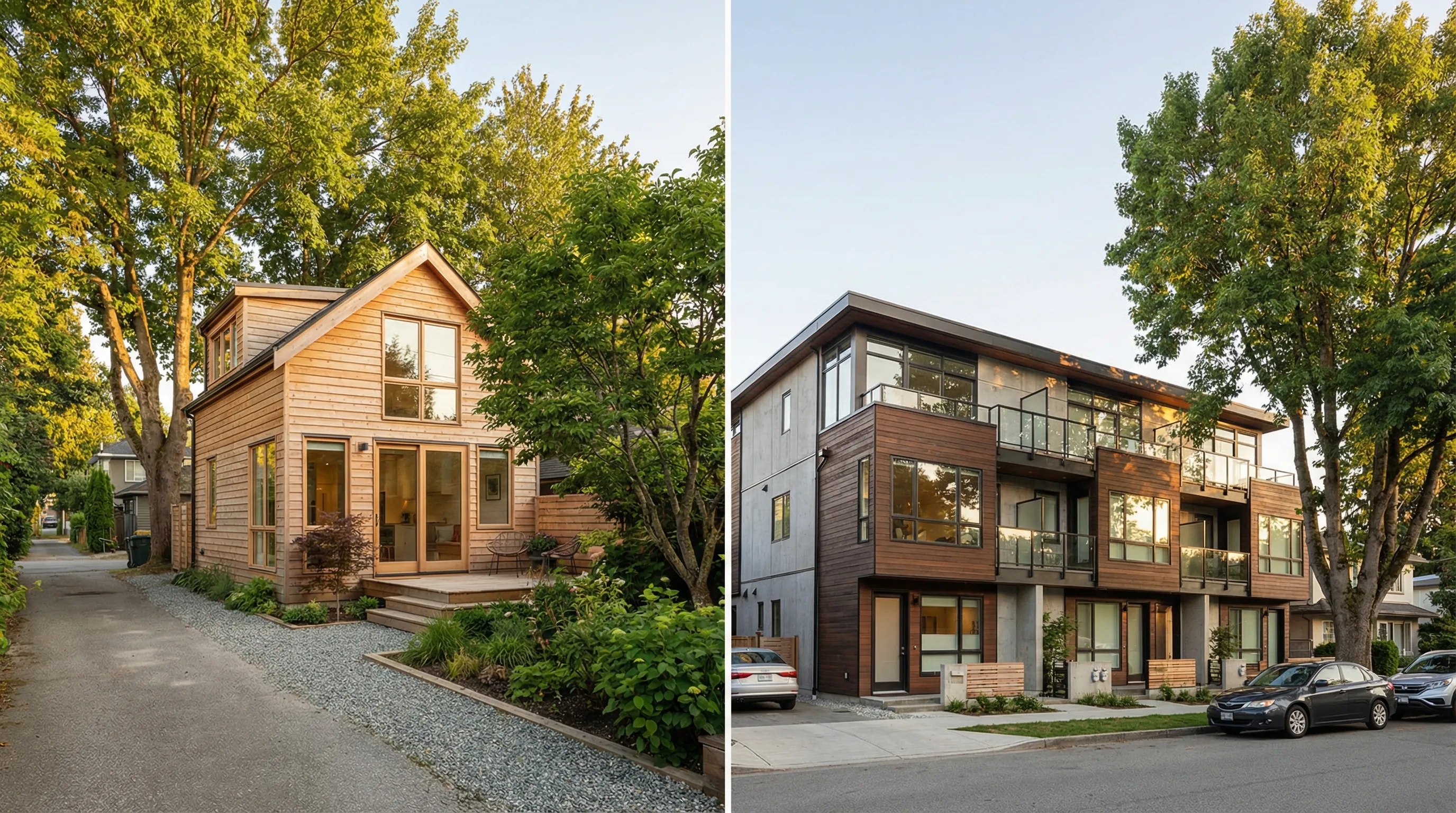
Summary: Comprehensive guide for Vancouver seniors exploring multiplex development as a retirement and aging strategy, featuring detailed case studies, financial comparisons with traditional options (sell and rent, sell and buy condo), accessibility design considerations, and multi-generational partnership approaches.
Thirty percent of Vancouver seniors are renters facing affordability crisis. For homeowner seniors, multiplex development offers a path to stay in their neighbourhood, generate retirement income, and age in accessible new construction—all while leaving a meaningful inheritance.
Margaret called me two years ago, worried. At 72, she was caught between two impossible choices.
Her three-bedroom Kitsilano home had become too much to manage. The garden she’d tended for 35 years now overwhelmed her. The stairs to the second floor were getting harder. Maintenance costs ate into her fixed income.
But the alternatives looked worse. Selling would generate maybe $3 million—enough to buy a condo and have some money left. But condo prices in her neighbourhood started at $1.2 million for anything decent. Strata fees, property taxes, and living costs would consume her remaining capital over time. She’d spent four decades in this community. The thought of leaving, or of eventually running out of money in an expensive condo, kept her up at night.
Renting wasn’t better. A two-bedroom apartment in Kitsilano ran $3,200 monthly. Over 15 years—her remaining life expectancy at 72—that’s nearly $600,000 in rent. She’d be trading $3 million in home equity for a $600,000 rental expense with nothing at the end.
Then we talked about the third option: building a multiplex on her lot, keeping an accessible ground-floor unit, and letting the other units generate income or fund her retirement.
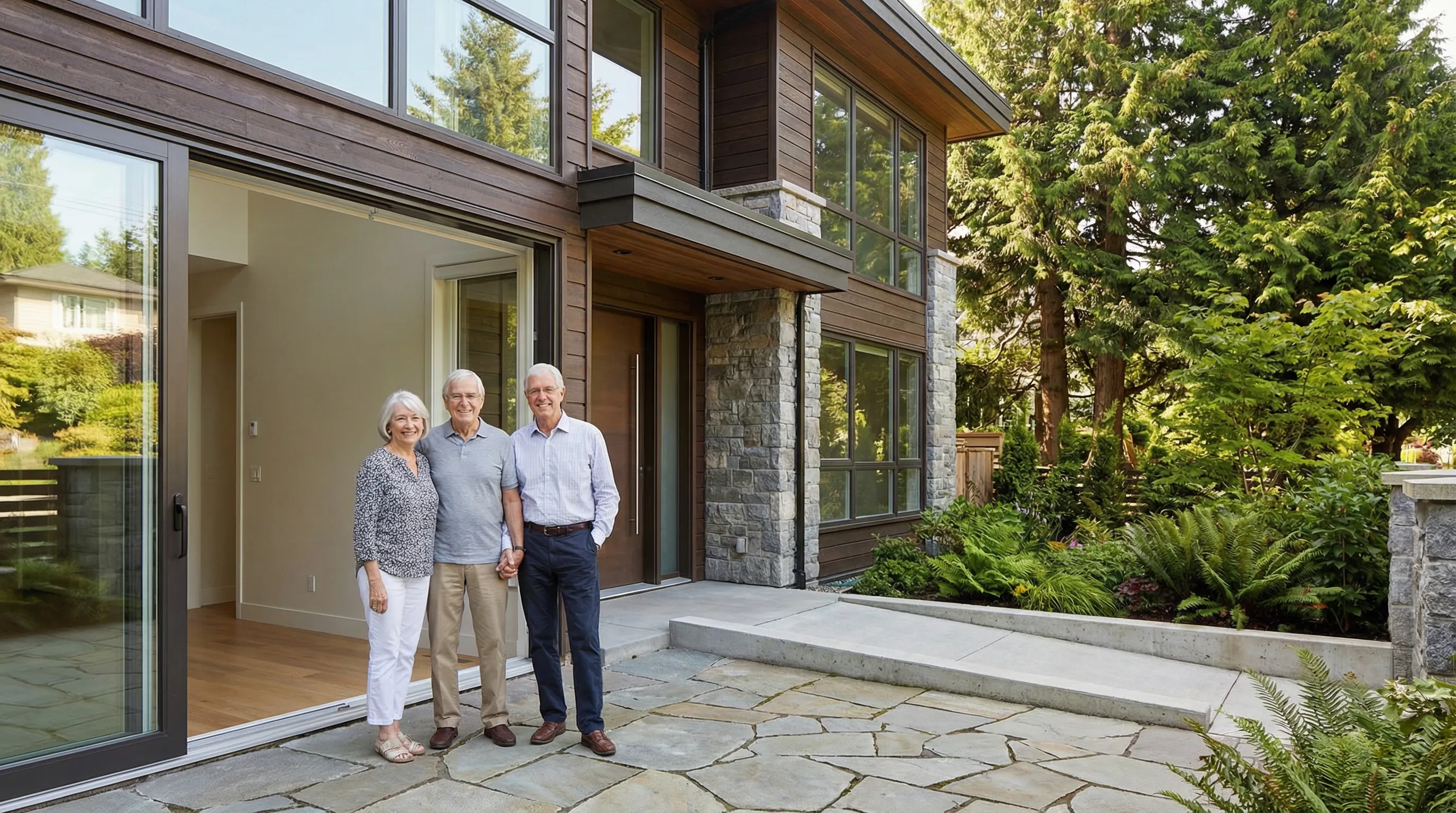
Today, Margaret lives in a brand-new, barrier-free unit steps from her daughter. She has no mortgage. She collects $8,500 monthly in rental income from the other units. And when she passes, her children will inherit property worth significantly more than the house she lived in before.
Margaret’s story isn’t unique. For Vancouver seniors with the right properties and circumstances, multiplex development is emerging as a powerful retirement strategy.
The Seniors Housing Crisis Nobody Discusses
Before getting to solutions, let me lay out the problem. Vancouver’s seniors housing situation is worse than most people realize.
The Rental Crisis
According to the City of Vancouver’s seniors housing data:
- 30% of Vancouver seniors are renters—roughly 45,000 households
- 14,100 senior renter households pay more than 30% of income on housing (the standard affordability threshold)
- 5,100 senior households pay more than 50% of income on housing—an immediate crisis level
- Seniors are Vancouver’s fastest-growing demographic—the 65+ population increased 18% since 2016
The rental market offers no relief. Purpose-built senior rental housing has long waitlists. Market rentals cost $2,500-$3,500+ monthly for decent apartments in established neighbourhoods. A senior on CPP and OAS—roughly $1,800 monthly—cannot afford market rent anywhere in Metro Vancouver.
The Homeowner Trap
Seniors who own homes aren’t necessarily better off.
The typical Vancouver senior homeowner:
- Bought decades ago for a fraction of current value
- Has significant home equity but limited liquid retirement savings
- Faces rising property taxes, maintenance costs, and utility expenses
- Lives in a home poorly suited to aging (stairs, large lots, deferred maintenance)
- Cannot access equity without selling or reverse mortgaging
They’re “house rich and cash poor”—with assets they can’t easily use and housing that no longer fits their needs.
The Missing Middle Ground
Vancouver’s housing market offers seniors two main options:
Option A: Stay in aging single-family home
- Familiar neighbourhood and community
- But growing maintenance burden
- But accessibility challenges
- But equity locked up
Option B: Sell and buy/rent elsewhere
- Access to equity
- But loss of community and independence
- But ongoing housing costs in expensive market
- But uncertainty about long-term affordability
What’s missing: housing that lets seniors stay in their neighbourhood, access their equity, and live in appropriate space.
Multiplex development creates that option.
How the Multiplex Strategy Works
The senior multiplex strategy has several variations, but the core concept is consistent: convert your single-family lot into multiple units, keep one for yourself, and let the others support your retirement.
Variation 1: Keep One, Sell the Rest
The scenario: You develop your lot into a sixplex. You keep one ground-floor unit designed for accessibility. You sell the other five units at market prices.
The math (Kitsilano example):
- Current home value: $3.2 million
- Development costs: $3.8 million (total project)
- Completed value: 6 units × $1.4 million = $8.4 million
Outcome:
- Sell 5 units: $7.0 million
- Less development costs: $3.8 million
- Less sales costs: $350,000
- Net cash: $2.85 million
- Retained unit value: $1.4 million
- Total position: $4.25 million (vs. $3.2 million pre-development)
Your situation:
- You live in a brand-new, accessible unit worth $1.4 million
- You have $2.85 million in cash
- No mortgage, no maintenance burden (strata handles it)
- Income from investment of cash: $100,000-$150,000/year at conservative yields
Variation 2: Keep One, Rent the Rest
The scenario: You develop the multiplex but keep all units as rentals. You live in one; the others generate monthly income.
The math:
- Development costs: $3.8 million (financed via construction loan, repaid from equity)
- Your unit: No rent paid (your home)
- 5 rental units at $3,200/month each: $16,000/month gross
- Less operating costs (15%): $13,600/month net
- Annual rental income: $163,200
Your situation:
- You live rent-free and mortgage-free
- You receive $163,000/year in income (replacing pension shortfall)
- You own assets worth $8.4 million
- Your children inherit both units and income stream
This variation requires significant equity to finance development or partnership with family/investors.
Variation 3: Multi-Generational Development
The scenario: You partner with adult children. They contribute capital; you contribute land. Multiple generations live in the completed building.
The structure:
- Your lot: Valued at $3.2 million (your contribution)
- Children contribute: $600,000 cash toward development costs
- Total project: $3.8 million development cost
- Children’s share: $600K / $3.8M = 16% of project
- Your share: $3.2M / $3.8M = 84% of project
Outcome:
- You keep ground-floor unit + receive proportional proceeds from sold units
- Children receive one unit or proportional cash
- Multiple generations live in same building or nearby
- Family wealth stays consolidated
This structure keeps families together while letting each generation build equity.
Case Study: Margaret’s Kitsilano Transformation
Let me walk through Margaret’s actual experience in detail.
Starting Position (2024)
Margaret, age 72, owned a 50’ × 122’ lot in Kitsilano. Her 1968 rancher was worth approximately $3.1 million—$2.8 million in land value, $300,000 in structure value. The house needed $150,000+ in deferred maintenance.
Her financial situation:
- Home: $3.1 million (no mortgage)
- Savings: $280,000 (RSP + cash)
- CPP + OAS income: $1,850/month
- Pension income: $1,200/month
- Total monthly income: $3,050
Her expenses:
- Property tax: $8,500/year ($708/month)
- Utilities: $450/month
- Maintenance: $500/month (average)
- Insurance: $300/month
- Food, transport, personal: $1,500/month
- Total monthly expenses: $3,458
Margaret was spending more than she earned, drawing down savings by $400/month. At that rate, she’d exhaust savings in about 50 years—longer than her life expectancy, but she worried about unexpected costs, health expenses, or longevity risk.
The Development Decision
After evaluating options, Margaret chose Variation 1: build a sixplex, keep one unit, sell five.
Her requirements:
- Ground-floor unit with no stairs
- In-suite laundry
- Easy maintenance (strata-managed building)
- Proximity to transit and amenities
- Minimal disruption during construction
The Development Process
Month 1-4: Design and partner selection Margaret worked with me to identify builders experienced with senior-friendly design. She selected a builder with 12 multiplex completions who agreed to a partnership structure: builder provides construction expertise and capital; Margaret provides land; returns split 70/30 in Margaret’s favour (reflecting her larger equity contribution).
Month 4-16: Permits and pre-construction During this period, Margaret continued living in her home. Permit timeline was 12 months—typical for Vancouver.
Month 16-18: Move out and demolition Margaret moved into a rental apartment. The builder covered rental costs as part of the partnership agreement.
Month 18-34: Construction 16 months of construction. Margaret visited monthly to monitor progress. Her ground-floor unit was designed to her specifications: wide doorways, curbless shower, single-level living, small private patio.
Month 35: Completion and move-in Margaret moved into her new unit. The other five units went to market.
The Outcome
Sales results:
- 5 units sold for average $1.42 million each = $7.1 million
- Less total project costs: $4.2 million
- Less sales costs (5%): $355,000
- Net proceeds: $2.545 million
Margaret’s share (70%): $1.78 million Builder’s share (30%): $765,000
Margaret’s final position:
- Ground-floor unit value: $1.42 million
- Cash from sales: $1.78 million
- Total: $3.2 million (plus brand-new, appropriate housing)
Comparison to selling original home:
- Original home sale would have netted ~$3.0 million (after costs)
- Multiplex route generated $3.2 million plus better housing
- Net gain: ~$200,000 plus dramatically improved living situation
Margaret’s New Financial Picture
Income:
- CPP + OAS: $1,850/month
- Pension: $1,200/month
- Investment income ($1.78M at 5%): $7,400/month
- Total: $10,450/month
Expenses:
- Strata fees: $550/month
- Property tax (unit): $3,000/year ($250/month)
- Insurance: $150/month
- Food, transport, personal: $1,500/month
- Total: $2,450/month
Net monthly surplus: $8,000
Margaret went from a $400/month deficit to an $8,000/month surplus. She can afford in-home care when needed, help her grandchildren with education, travel to visit family, and never worry about outliving her money.
The Accessibility Factor
For seniors considering multiplex development, accessibility design is critical. You’re building your forever home—it needs to work as your mobility changes.
Universal Design Principles
Universal design creates spaces that work for everyone, regardless of age or ability. Key features:
Entry:
- No-step entrance (grade-level or with ramp)
- Wide doorways (36” minimum, 42” preferred)
- Lever handles throughout
- Well-lit approach
Main Living:
- Open floor plan minimizing hallways
- Single-level living (all necessities on one floor)
- Flooring transitions minimized or eliminated
- Electrical outlets at accessible heights
Kitchen:
- Varied counter heights
- Pull-out shelving
- Side-by-side refrigerator
- Front-mounted controls on appliances
Bathroom:
- Curbless (roll-in) shower
- Grab bars (or blocking for future installation)
- Comfort-height toilet
- Vanity with knee clearance option
Bedroom:
- Direct bathroom access
- Adequate circulation space
- Window egress if required
Vancouver’s Accessibility Requirements
Under BC Building Code and Vancouver’s multiplex guidelines:
- Visitability requirements: One entrance accessible; main floor bathroom accessible
- Adaptable features: Many buildings must include features allowing future accessibility upgrades
- Senior-focused design: Not mandated, but increasingly common for ground-floor units
If you’re developing for yourself, specify accessibility features beyond minimum code requirements. The cost increment is modest during construction; retrofitting later is expensive.
Design Considerations for Aging
Beyond accessibility, consider:
Location within building:
- Ground floor minimizes elevator dependence
- Direct exterior access provides emergency egress and garden connection
- Corner units offer more natural light and ventilation
Unit configuration:
- Open sightlines between kitchen and living areas
- Bathroom close to bedroom for nighttime access
- Storage accessible without climbing or reaching
Outdoor space:
- Private patio or garden connection maintains gardening lifestyle
- Low-maintenance landscaping reduces burden
Technology:
- Wiring for smart home systems
- Video doorbell and intercom
- Medical alert system compatibility
Financial Comparison: Three Retirement Paths
Let me compare three common paths for Vancouver seniors with similar starting positions:
Scenario: 72-year-old with $3.2M home, $300K savings
Path A: Stay in Current Home
Year 1-10 projection:
- Annual deficit: $4,800 ($400/month × 12)
- Cumulative shortfall: $48,000
- Major repairs (estimate): $100,000
- Savings remaining at year 10: $152,000
At year 10: Savings nearly depleted, maintenance challenges mounting, stairs increasingly difficult.
Path B: Sell Home, Buy Condo
Initial:
- Home sale proceeds: $3,050,000 (net)
- Condo purchase: $1,200,000
- Remaining after purchase: $1,850,000 + original $300,000 = $2,150,000
Year 1-10:
- Strata fees: $700/month ($84,000 over 10 years)
- Property taxes: $6,000/year ($60,000 over 10 years)
- Additional living costs: covered by investment income
- Net investment income (5% on $2.15M): ~$107,500/year
At year 10: Still financially solid, but condo has appreciated modestly, and living in standardized housing without community connection established over 40 years.
Path C: Multiplex Development (Margaret’s Approach)
Initial investment: $0 (land equity covers share) 24-month development period: Some carrying costs covered by partner
Post-development:
- Cash position: $1,780,000 + original $300,000 = $2,080,000
- Unit value: $1,420,000
- Total: $3,500,000
Year 1-10:
- Investment income (5% on $2.08M): ~$104,000/year
- Living costs: ~$30,000/year
- Net annual surplus: ~$74,000
At year 10:
- Cash grown to ~$2,800,000 (assuming 5% growth, $74K annual additions)
- Unit appreciated to ~$1,700,000 (assuming 2% annual growth)
- Total position: ~$4,500,000
Path C generates ~$1 million more wealth over 10 years than Path B, while providing custom-designed accessible housing in the original neighbourhood.
The Multi-Generational Partnership Model
Some seniors partner with adult children or other family members. This approach has distinct advantages and challenges.
Why It Works
For seniors:
- Reduces capital requirements
- Keeps family nearby
- Shares development risk
- Creates legacy asset for family
For adult children:
- Entry into expensive market with family support
- Proximity to aging parents (caregiving considerations)
- Shared equity building
- Future inheritance clarity
Structure Considerations
Successful multi-generational partnerships require clear agreements:
Ownership structure:
- Individual strata ownership (each generation owns their unit)
- Proportional ownership based on contribution
- Clear exit mechanisms if circumstances change
Financial contributions:
- How much does each party contribute?
- How are cost overruns handled?
- How are proceeds divided if units sell?
Living arrangements:
- Who gets which unit?
- What about visitors, noise, shared spaces?
- What if relationships deteriorate?
Future scenarios:
- What happens if parent needs care?
- What if child wants to sell?
- What happens at parent’s death?
Work with a family lawyer to document agreements. Informal arrangements between relatives frequently become disputes.
Case Study: The Yamamoto Family
Three-generation partnership in Hastings-Sunrise:
Participants:
- George (78) and Helen (76): Owned 48’ × 120’ lot valued at $2.6 million
- David (52) and Karen (50): Their son and daughter-in-law, contributed $400,000
- Two adult grandchildren: Interested in eventual ownership
Structure:
- George/Helen: 80% ownership (land contribution)
- David/Karen: 20% ownership (cash contribution)
- Grandchildren: Right of first refusal on future sales
Development:
- 5-unit multiplex (lot slightly below maximum threshold)
- George/Helen keep ground-floor accessible unit
- David/Karen keep one upper unit
- Three units sold to fund development
Outcome:
- George/Helen: Accessible unit + $1.2 million cash
- David/Karen: Unit worth $980,000 for $400,000 investment
- Grandchildren: Clear path to purchasing family units later
- Three generations now live within 50 feet of each other
When Multi-Generational Doesn’t Work
Not all families should partner:
- Existing relationship tensions: Development stress amplifies problems
- Unequal financial positions: Creates resentment
- Different risk tolerances: One party may want conservative approach while other pushes for maximization
- Geographic distance: Hard to partner when family lives elsewhere
- Complexity aversion: Some families prefer clean, simple arrangements
If partnership isn’t right, independent development (or selling to a developer) may be better.
Risks and Considerations for Seniors
Multiplex development isn’t right for every senior. Consider these factors honestly:
Health and Timeline
Development takes 24-36 months. If you have serious health conditions with uncertain prognosis, the timeline may not work. Consider:
- Can you handle 2+ years of disruption?
- What if health changes during construction?
- Do you have capacity to make decisions throughout the process?
If health concerns are significant, selling to a developer captures some premium immediately with less complexity.
Cognitive Capacity
Development involves complex decisions, contract negotiations, and ongoing management. Ensure you (or a trusted family member with power of attorney) have capacity to navigate the process.
Displacement Challenges
Moving twice in retirement (out during construction, back into new unit) is disruptive. Consider:
- Where will you live during construction?
- Can you handle the stress of multiple moves?
- What about medical relationships, social connections, routines?
Some seniors find the displacement manageable; others find it overwhelming.
Family Dynamics
If you’re involving family, be realistic about relationships:
- Will involvement create tension or obligation?
- Are all family members aligned on goals?
- What happens if family relationships change?
Financial Complexity
Development involves significant financial exposure. Even with experienced partners, you’re at risk if:
- Construction costs overrun dramatically
- Market values decline
- Partner defaults
Ensure you understand and can tolerate the risks before proceeding.
Frequently Asked Questions
At what age does this strategy make sense?
Generally 65-75 is ideal. Younger seniors have time to navigate the 2-3 year process. Much older seniors may find the timeline and disruption challenging. But individual circumstances vary—health, support network, and urgency matter more than chronological age.
Can I do this if I have a mortgage?
It depends on mortgage size. If you have significant equity (70%+), it’s potentially feasible. If your mortgage exceeds 40-50% of property value, the math becomes difficult. Pay down the mortgage first, or consider selling instead.
What about reverse mortgages as an alternative?
Reverse mortgages can access equity without moving, but:
- Interest compounds over time, eroding equity
- Typically limited to 20-55% of home value
- Doesn’t address accessibility or maintenance issues
- Reduces inheritance for heirs
For some seniors, reverse mortgage is appropriate. For those with development-suitable lots, multiplex typically generates better outcomes.
How do strata fees compare to home maintenance costs?
Strata fees for new multiplexes run $400-$700/month. This covers:
- Building insurance
- Common area maintenance
- Contingency fund contributions
- Property management
Compare to single-family costs:
- Insurance: $200-$400/month
- Maintenance reserve: $300-$600/month
- Garden/exterior upkeep: $100-$400/month
Net difference is often modest, but strata eliminates personal responsibility for repairs.
What happens to my unit when I pass away?
Your strata unit passes through your estate like any property. You can leave it to:
- Spouse (if applicable)
- Children (equal or specific distribution)
- Trust (for complex family situations)
Work with an estate lawyer to ensure your unit integrates with your overall estate plan.
Can I rent out my unit if I need to move to care?
Yes. Strata units can be rented (subject to any rental restrictions in the strata’s bylaws—which you can influence since you’re a participant in the development). If you eventually need full-time care, your unit can generate income to help fund it.
Is This Right for You?
The senior multiplex strategy works for homeowners who:
- Own single-family lots with development potential (5,995+ sq ft, 49.5’+ width)
- Want to stay in their neighbourhood
- Can handle 2-3 years of process and displacement
- Have realistic expectations about complexity and risk
- Either have financial capacity or family partners
It may not work for:
- Seniors with significant health concerns or limited timeline
- Properties that don’t support efficient development
- Those who prefer simplicity over optimization
- Seniors without support network to navigate the process
The decision deserves careful analysis of your specific property, financial situation, family circumstances, and personal preferences.
Getting Started
If you’re a Vancouver senior exploring housing options—whether multiplex development, selling to a developer, or other paths—the starting point is understanding your specific situation.
What’s your property actually worth, and what’s its development potential? What would different strategies produce financially? What trade-offs are you willing to accept?
I help Vancouver seniors work through these questions. The goal isn’t to sell you on a particular strategy—it’s to give you clarity on your options so you can make the decision that fits your life.
Contact Greyden Douglas directly at (604) 218-2289 or book a call to discuss your Vancouver real estate goals.
Related Vancouver real estate pages
Continue with local service pages, neighbourhood guides, and actionable resources related to this topic.