Eighteen months after BC launched Bill 44, Burnaby's restrictive bylaw amendments reveal the tension between provincial housing goals and municipal control. An analysis of what's working, what isn't, and how recent changes could reshape the next decade of housing supply.
Eighteen months after British Columbia launched Bill 44—the Small-Scale Multi-Unit Housing (SSMUH) initiative—the province’s ambitious plan to unlock Missing Middle housing has delivered both momentum and unexpected friction. Hundreds of multiplex permit applications have been submitted across BC, the first completed projects are emerging, and municipalities like North Vancouver are officially adopting the provincial framework. Yet beneath this progress lies a more complex reality: the path to delivering attainable, family-oriented density is proving far more challenging than proponents anticipated.
Nowhere is this tension more evident than in Burnaby, one of Bill 44’s earliest and most enthusiastic adopters, which has now become one of its loudest critics. In response to resident concerns about scale, height, setbacks, and parking, Burnaby has revised its bylaws—reducing allowable building height, shrinking lot coverage, expanding setbacks, and increasing parking requirements. These changes may ease neighbourhood anxiety, but they also directly threaten the number of new homes that can realistically be built under the Missing Middle framework.
The Bill 44 Promise: What Was Supposed to Happen
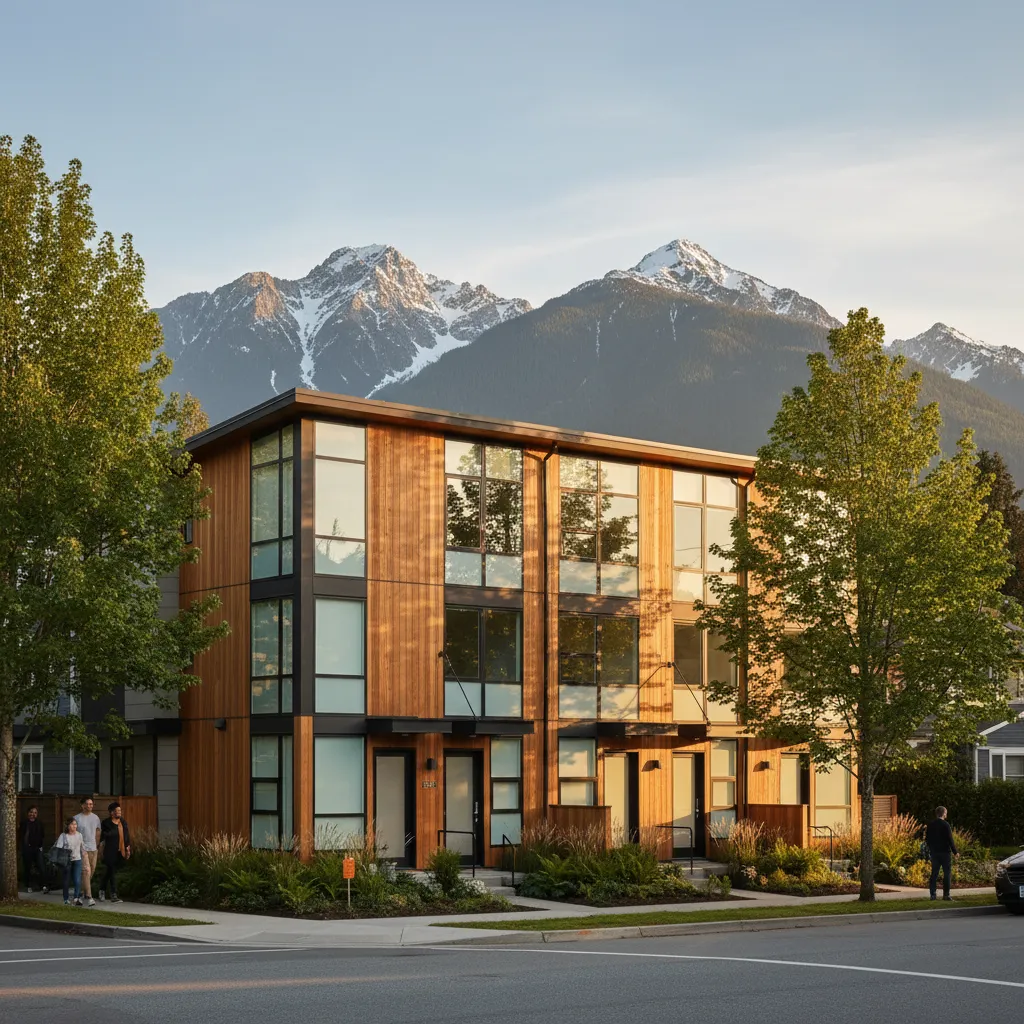
When the BC government introduced Bill 44 in 2023, the policy was designed to address the province’s severe housing shortage by legalizing small-scale multi-unit housing (3-6 units) on single-family lots across municipalities. The goal was clear: create “Missing Middle” housing—homes that bridge the gap between single-family houses and large apartment buildings—while maintaining neighbourhood character.
The provincial framework set baseline standards:
- Up to 6 units allowed on most single-family lots
- Maximum 4 storeys in height
- Reduced parking requirements (0.5-1 space per unit)
- Streamlined permitting processes
- Density bonuses for net-zero energy buildings
Municipalities were given authority to adopt the framework but couldn’t impose stricter limits than provincial minimums without demonstrating “exceptional circumstances.”
Early adoption was strong. Vancouver, North Vancouver, Burnaby, and other Lower Mainland cities moved quickly to implement SSMUH zoning. Developer interest surged. By late 2025, over 400 multiplex permit applications had been submitted across Metro Vancouver alone.
The Reality Check: Burnaby’s Bylaw Revisions
Burnaby’s recent bylaw changes reveal the collision between provincial housing goals and municipal autonomy. After 18 months of Bill 44 implementation, the city has introduced amendments that significantly constrain multiplex feasibility:
Height Reductions
- Previous: 4 storeys permitted under provincial framework
- New: 3 storeys maximum in most residential zones
- Impact: Reduces density by 25%, limiting the number of achievable units on standard lots
Expanded Setbacks
- Previous: Standard 10-15 foot setbacks
- New: 20-25 foot setbacks in many neighbourhoods
- Impact: Shrinks buildable envelope, making 5-6 unit projects financially unviable on typical 33-50 foot lots
Increased Parking Requirements
- Previous: 0.5-1 space per unit (aligned with transit-oriented development principles)
- New: 1.5 spaces per unit, plus visitor parking
- Impact: A 6-unit building now requires 9+ parking spaces, consuming ground-floor area that could otherwise provide additional housing or green space
Reduced Lot Coverage
- Previous: Up to 50% lot coverage allowed
- New: 40% maximum in some zones
- Impact: Further constrains building footprint, making higher unit counts impossible
These changes are politically defensible—residents concerned about neighbourhood “character” have been vocal—but economically, they undermine the core promise of Bill 44: unlocking significant new housing supply.
Why This Matters: The Feasibility Crisis
Multiplex development operates on razor-thin margins. Unlike large-scale apartment projects, Missing Middle housing involves small builders working on individual lots with limited economies of scale. Every constraint—height, setback, parking—directly affects project viability.
Construction Cost Reality
As of 2026, construction costs in Metro Vancouver average $350-500 per square foot for wood-frame multiplex buildings. A typical 6-unit project (6,000-8,000 sq ft) costs $2.1-4 million to build, plus:
- Land acquisition: $1-2.5 million (depending on neighbourhood)
- Soft costs (permits, consultants, financing): 15-20% of hard costs
- Municipal fees: $50,000-150,000
Total project cost: $3.5-7 million
For this to pencil out, builders need to sell or rent enough units to cover costs plus a reasonable return. Burnaby’s new restrictions reduce the number of units from 6 to 4-5, increasing per-unit costs by 20-33%. Many projects that were feasible under the original framework are no longer viable.
Financing Challenges
Small-scale builders face unique financing hurdles:
- Construction loans: Banks view 4-6 unit projects as higher risk than large apartment developments, demanding 30-40% equity
- Pre-sale requirements: Lenders often require 50%+ pre-sales before funding, but buyers are hesitant to commit to strata multiplexes at premium prices
- CMHC MLI Select: This federal program offers favorable financing for purpose-built rental housing, but many municipalities (including Burnaby) require projects to be 100% rental to qualify, eliminating the option to sell units and recoup equity
The result: many would-be developers are walking away, unable to secure financing for projects that meet Burnaby’s new bylaws.
The Political Friction: Provincial Goals vs. Municipal Control
BC’s housing crisis is a provincial emergency, but land use authority remains municipal. This creates inevitable tension.
The province argues municipalities are undermining Bill 44’s intent by imposing constraints that make Missing Middle housing economically unviable. Municipalities counter that they’re responding to legitimate resident concerns about neighbourhood livability, parking pressure, and infrastructure capacity.
North Vancouver’s Contrasting Approach
Just as Burnaby was restricting development, North Vancouver officially passed its SSMUH zoning amendments—with minimal modifications to the provincial framework. The city embraced:
- Full 4-storey heights in most zones
- Reduced parking (1 space per unit near transit)
- Streamlined permitting
Early signals suggest North Vancouver will see significantly more multiplex activity than Burnaby, despite being one of the most land-constrained communities in the region.
The lesson: municipal implementation choices will determine whether Bill 44 succeeds or stalls.
Can Multiplexes Actually Improve Affordability?
This is the critical question. Bill 44 was sold as an affordability solution, but early evidence suggests a more nuanced reality.
The Affordability Paradox
Most new multiplex units are selling as strata condos at $600,000-900,000+ depending on neighbourhood and finish level. A 4-unit strata building in Burnaby’s Metrotown area might list at:
- 2-bed units: $750,000-850,000
- 3-bed units: $900,000-1,100,000
These prices are hardly “attainable” for median-income families. Critics argue Bill 44 is simply creating another form of expensive, stratified ownership rather than solving the affordability crisis.
Where Affordability Can Work
Affordability gains are most achievable when:
- Purpose-built rental: Owners hold buildings long-term, spreading costs over decades and benefiting from rental income tax advantages
- Generational housing: Families develop multiplexes to house extended family (grandparents, adult children), sharing equity and eliminating market-rate pricing
- Non-profit/co-op development: Community land trusts and housing co-ops can leverage subsidies and remove profit motive
The challenge: Burnaby’s new bylaws make all three models harder to execute profitably.
The Builder’s Perspective: What Would Actually Help
Based on conversations with developers, builders, and industry experts deeply involved in Missing Middle housing, several practical solutions could unlock real progress:
1. Streamline Permitting
Current timelines: 12-18 months from application to permit approval. This carrying cost (land taxes, financing fees) adds $100,000-300,000 to project costs. A 6-month streamlined process would significantly improve feasibility.
2. Reduce Parking Requirements Near Transit
Burnaby’s 1.5 spaces per unit mandate is out of step with climate goals and transit-oriented development principles. Near SkyTrain stations and frequent bus routes, 0.5-1 space per unit is sufficient and frees up ground floor area for more housing.
3. Allow Mixed Tenure (Rental + Strata)
Let builders sell 2-3 units to recoup equity while retaining 2-3 as long-term rentals. This hybrid model improves financing feasibility while maintaining rental supply.
4. Density Bonuses That Actually Work
BC’s net-zero density bonus (allowing 7-8 units for energy-efficient buildings) is underutilized because the incremental cost of net-zero construction (~15-20% premium) often exceeds the value of additional units. Municipalities should offer property tax exemptions or DCL (Development Cost Levy) reductions to make these bonuses financially attractive.
5. Pre-Approved Designs
Vancouver’s “pre-approved multiplex designs” program allows builders to skip architectural review for standardized, pre-vetted building types. This cuts soft costs by 20-30% and accelerates timelines. Burnaby should adopt a similar model.
What’s Next: The Future of Missing Middle Housing in BC
Bill 44 is at a crossroads. The next 12-24 months will determine whether BC’s Missing Middle initiative delivers meaningful housing supply or becomes another well-intentioned policy undermined by municipal resistance and economic reality.
Best Case Scenario
Municipalities like North Vancouver, Vancouver, and Victoria maintain streamlined, developer-friendly frameworks. Construction costs stabilize. Financing becomes more accessible. By 2028, thousands of new multiplex units are completed annually, meaningfully expanding housing supply and creating attainable ownership opportunities for families.
Worst Case Scenario
More municipalities follow Burnaby’s lead, adding constraints that make most projects unviable. Builder interest evaporates. Bill 44 delivers only a few hundred new units per year—a rounding error in a region that needs 10,000+ new homes annually. The Missing Middle remains missing.
Most Likely Outcome
A mixed result. Some municipalities (North Vancouver, Vancouver, New Westminster) will see significant multiplex activity. Others (Burnaby, West Vancouver, parts of Richmond) will constrain development through restrictive bylaws. The result: pockets of success, but not the transformational housing supply the province needs.
Key Takeaways
- Bill 44 has delivered early momentum, but implementation varies wildly by municipality
- Burnaby’s bylaw revisions significantly constrain multiplex feasibility, reducing allowable height, increasing setbacks, and mandating more parking
- Construction costs and financing challenges make small-scale multi-unit development difficult even under favorable zoning
- Affordability remains elusive for most market-rate multiplex projects, though purpose-built rental and generational housing models show promise
- Municipal implementation choices will determine success—North Vancouver’s streamlined approach contrasts sharply with Burnaby’s restrictions
- Practical solutions exist: streamlined permitting, reduced parking near transit, mixed tenure allowances, and pre-approved designs could unlock meaningful progress
Frequently Asked Questions
What is Bill 44 and how does it affect Vancouver real estate?
Bill 44 (Small-Scale Multi-Unit Housing Act) is BC provincial legislation passed in 2023 that legalizes 3-6 unit multiplex buildings on single-family lots across most municipalities. The policy aims to create Missing Middle housing—attainable homes between detached houses and large apartments—by allowing small-scale density in traditionally single-family neighbourhoods. Implementation began in 2024, with municipalities required to adopt the framework or demonstrate exceptional circumstances for deviation.
Why did Burnaby change its multiplex bylaws?
Burnaby revised its SSMUH bylaws in response to resident concerns about building scale, neighbourhood character, parking pressure, and infrastructure capacity. The city reduced maximum building height from 4 storeys to 3, expanded setback requirements, increased mandatory parking from 0.5-1 spaces per unit to 1.5 spaces, and reduced allowable lot coverage. While these changes address neighbourhood concerns, they also significantly reduce the number of units that can be built economically on typical lots.
Are multiplex units actually affordable in 2026?
Most new market-rate multiplex units sell for $600,000-900,000+ as strata condos, making them unaffordable for median-income families. True affordability is more achievable through purpose-built rental projects (where owners hold long-term and spread costs over decades), generational housing developments (where families build to house extended family members), or non-profit/co-op models. The high cost of land, construction ($350-500/sq ft), and municipal fees make it difficult for private developers to deliver truly attainable ownership without subsidies.
How do Bill 44 rules differ between Vancouver and Burnaby in 2026?
Vancouver has maintained closer alignment with the provincial framework: allowing up to 4 storeys, reduced parking requirements (0.5-1 space per unit near transit), and streamlined permitting through pre-approved designs. Burnaby has imposed stricter limits: 3 storey maximum, 1.5 parking spaces per unit, larger setbacks, and reduced lot coverage. These differences significantly affect project feasibility—many multiplex projects viable in Vancouver are not economically feasible in Burnaby under the new bylaws.
What neighbourhoods in Vancouver are best for multiplex investment?
The most promising neighbourhoods for multiplex investment in 2026 combine strong rental demand, proximity to transit, favorable municipal zoning, and reasonable land costs. Key areas include Mount Pleasant (high rental demand, near SkyTrain), Kitsilano (strong family appeal, transit access), Grandview-Woodland (emerging area, affordable land), and areas near the Cambie Corridor (future SkyTrain expansion). North Vancouver is also emerging as a strong market due to the city’s developer-friendly SSMUH implementation.
How long does it take to get a multiplex permit in Metro Vancouver?
Permit timelines vary significantly by municipality. Vancouver’s streamlined process (especially for pre-approved designs) can deliver permits in 6-9 months. Burnaby, Surrey, and Richmond typically require 12-18 months from application to permit approval. These timelines include rezoning (if required), development permit review, building permit processing, and addressing any neighbour objections. Carrying costs during this period (property taxes, financing fees) can add $100,000-300,000 to project costs, making timeline efficiency critical for feasibility.
Next Steps: Navigate the Missing Middle with Expert Guidance
Understanding Bill 44’s evolving landscape—and which municipalities offer genuine opportunity—requires local expertise and builder connections. Whether you’re a homeowner considering developing your property into a multiplex, an investor evaluating Missing Middle opportunities, or simply curious about how these policy changes affect your neighbourhood’s future, having an experienced real estate advisor matters.
Greyden Douglas and the Rain City Properties team have spent nearly 20 years building relationships with Vancouver’s top builders and developers. We understand which projects pencil out, which neighbourhoods offer the best risk-adjusted returns, and how to navigate municipal processes that can make or break feasibility.
Contact Greyden Douglas directly at (604) 345-9977 or book a consultation to discuss how Bill 44 and Missing Middle housing trends affect your real estate strategy. Whether you’re buying, selling, or developing, we’ll give you the straight answers you need.
Want to learn more about multiplex investment opportunities? Visit our multiplex zoning guide for comprehensive information on Vancouver’s R1-1 regulations.
Related Vancouver real estate pages
Continue with local service pages, neighbourhood guides, and actionable resources related to this topic.