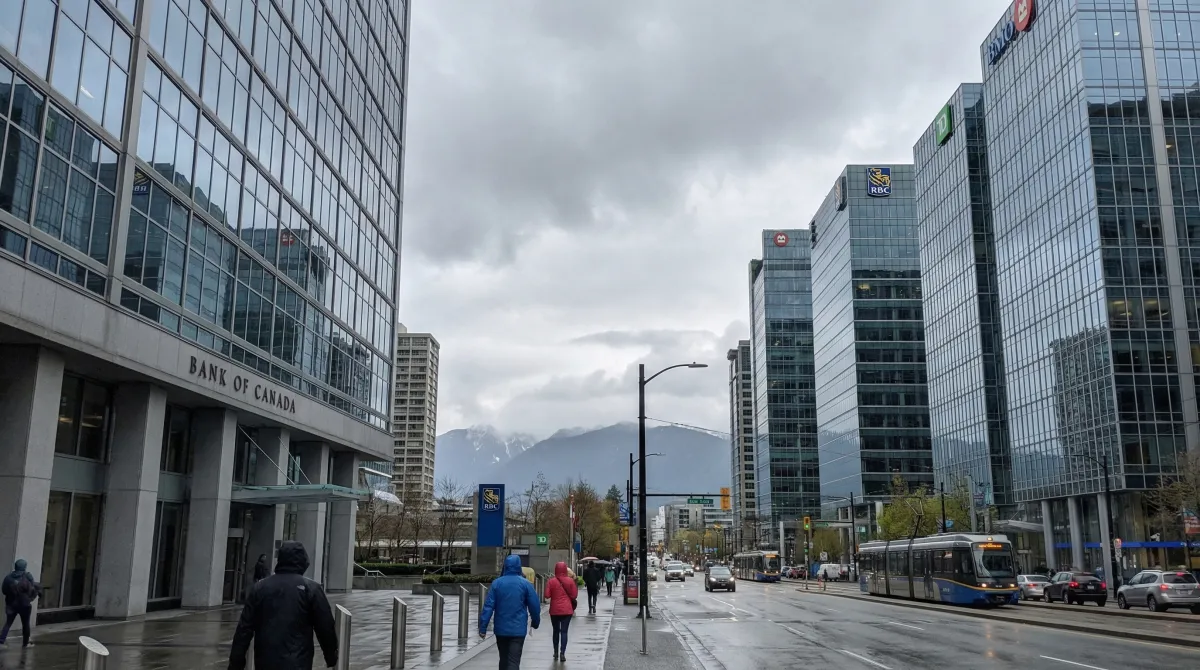
The Bank of Canada is almost certainly holding at 2.25% again on March 18. After seven cuts and now three straight pauses, here's what the rate plateau means for Vancouver mortgage rates, buying power, and your next move.
On March 18, the Bank of Canada will announce its second rate decision of 2026. And barring something truly unexpected, the overnight rate is staying at 2.25%.
Bond markets are pricing in roughly a 96% probability of no change on March 18. Four of Canada’s Big Six banks (TD, CIBC, National Bank, and RBC) all expect 2.25% to hold through the rest of 2026. If you have been watching the rate tea leaves, the message is about as clear as it gets: we are in a plateau.
That is not bad news. But it does change the math for anyone buying, selling, or refinancing in Vancouver right now. Let me walk through what matters.
The March 18 Decision: Why Another Hold Is Coming
When the BoC held at 2.25% on January 28, Governor Macklem was blunt about why. Tariffs and trade uncertainty are making it impossible to forecast where the economy is going. His exact words: “Monetary policy cannot compensate for the structural damage caused by tariffs.”
That sentence tells you everything. The Bank is not going to cut its way out of a trade war. And until the trade picture clears up, particularly around the CUSMA review starting July 1, the BoC is going to sit tight.
Nothing has changed since January to alter that calculus. CPI inflation eased to 2.3% in January 2026, down from 2.4% in December and right near target. The BoC’s own GDP forecast calls for 1.1% growth in 2026, while CMHC is even more conservative at 0.7%. The economy is growing, but barely. Unemployment sits at 6.8%.
In that environment, cutting would risk stoking inflation with no clear economic benefit. Hiking would choke what little growth exists. Holding is the only move that makes sense.
What the Rate Plateau Means for Mortgage Rates Right Now
Here is where it gets practical. If you are shopping for a mortgage in Vancouver today, these are the numbers you are working with.
As of March 3, 2026, the best available rates from WOWA.ca’s daily lender survey are:
| Mortgage Type | Insured (less than 20% down) | Uninsured (20%+ down) |
|---|---|---|
| 5-Year Fixed | 3.64% | 3.69% |
| 5-Year Variable | 3.34% | 3.40% |
Source: WOWA.ca Best Mortgage Rates, March 3, 2026
The prime rate is 4.45%, and it is not going anywhere on March 18. That means variable-rate mortgage payments stay exactly where they are. If you have a variable-rate mortgage or HELOC, you can stop holding your breath.
For context, these rates are roughly half what they were at the peak in late 2023. A 5-year fixed at 3.64% is a good rate by any historical standard. We just got used to the 2% era, and that is not coming back.
Fixed vs Variable: Which Makes Sense for Vancouver Buyers
This is the question I get most often right now, and my answer has gotten more nuanced as the rate plateau has extended.
The case for variable. If you believe the BoC has at most one more cut left in 2026 (which is where I lean), variable gives you a modest savings today. The spread between the best fixed and variable rates is only about 30 basis points. Over 5 years, that difference on a $700,000 mortgage is roughly $90/month. Not life-changing, but not nothing.
The real value of variable is optionality. If the economy deteriorates sharply and the BoC does cut, you benefit immediately. And Scotiabank, the one outlier among the Big Six, actually forecasts a rate increase to 2.75% by year-end. If that scenario plays out, variable holders face a modest increase but can convert to fixed.
The case for fixed. If you want certainty and peace of mind, lock in at 3.64%-3.69%. You know exactly what your payments look like for five years. With tariff uncertainty, CUSMA review risk, and an economy that CMHC says could tip into a mild recession, there is something to be said for removing rate risk from the equation entirely.
My honest take: for most Vancouver buyers right now, fixed is the safer play. The savings from variable are slim, and the uncertainty in the economy is high. But talk to your mortgage broker about your specific situation. I am not a mortgage advisor, and the right call depends on your risk tolerance and cash reserves.
For a deeper breakdown, see our Vancouver mortgage guide.
Buying Power Math: What 2.25% Actually Gets You
Let me put real numbers on what the rate environment means for a Vancouver purchase. The stress test still applies, and that is the binding constraint for most buyers.
Under OSFI’s current rules, you qualify at the higher of 5.25% or your contract rate plus 2%. At today’s best 5-year fixed of 3.64%, that means qualifying at 5.64%. Here is what that looks like at different income levels:
| Household Income | Approx. Max Mortgage (25-yr amortization) | Max Purchase (20% down) |
|---|---|---|
| $120,000 | ~$520,000 | ~$650,000 |
| $150,000 | ~$650,000 | ~$812,000 |
| $180,000 | ~$780,000 | ~$975,000 |
| $210,000 | ~$910,000 | ~$1,137,000 |
Estimates assume no other debts, property taxes of $4,000/year, heat at $100/month. For illustration only. Verify with your mortgage broker.
Look at those numbers alongside February’s GVR benchmark prices: condos at $708,200, townhouses at $1,046,100, and detached at $1,835,900. A household earning $150,000 can qualify for a condo but not a townhouse. Getting into a detached home requires roughly $210,000+ in household income, and that is with 20% down.
The third consecutive hold does not change this math. It just confirms it. And I think that is actually useful information for buyers who have been sitting on the sidelines waiting for rates to fall further. This is likely as good as it gets for the foreseeable future.
Vancouver’s Market During the Rate Plateau
The rate holds are landing in a market that continues to soften. Greater Vancouver Realtors’ February 2026 data tells the story:
| Metric | February 2026 | Year-over-Year Change |
|---|---|---|
| Total Sales | 1,648 | -9.8% |
| Composite Benchmark | $1,100,300 | -6.8% |
| Detached Benchmark | $1,835,900 | -8.8% |
| Condo Benchmark | $708,200 | -6.8% |
| Townhouse Benchmark | $1,046,100 | -5.6% |
| Active Listings | 13,545 | +6.3% |
Source: Greater Vancouver Realtors, February 2026 Monthly Report
February sales were 28.7% below the 10-year seasonal average, and active listings sit 37% above the 10-year average. That is a buyer’s market by any reasonable measure. The sales-to-active ratio is 12.6%, firmly in balanced-to-buyer territory.
Here is what I find interesting: prices are declining even though borrowing costs have dropped substantially from their 2023 peaks. Seven rate cuts and we still have falling benchmarks. That tells you this is about confidence and psychology more than affordability. Buyers can afford to buy. Many are choosing not to because they feel uncertain about the economy, trade, and whether prices will keep slipping.
What Happens After March 18
The next BoC decision is April 29, 2026, and it comes with a new Monetary Policy Report. That one matters more than March because the Bank will have fresh GDP and inflation projections incorporating Q1 data and any tariff developments.
My read on the rest of 2026: rates stay at 2.25%. Maybe we get one 25-basis-point cut if the economy weakens materially. Maybe Scotiabank is right and we see a bump to 2.50% if inflation gets sticky. Either way, we are talking about small moves in a narrow range. The era of dramatic 50-basis-point cuts is behind us.
For Vancouver real estate, that means a few things. BCREA’s Q1 2026 forecast projects 78,690 residential sales across BC this year, up 12% from 2025’s depressed levels, with the average price rising about 3% to $982,800. That is a province-wide number. Metro Vancouver, with its higher price points and steeper declines, will probably see something closer to flat.
CMHC is warning that downside risks are more likely than upside risks, and a mild recession is possible if business investment keeps pulling back. I am not predicting a recession. But the possibility is worth factoring into your timeline.
If you have been on the fence, the honest assessment is this: rates are stable, prices are soft, and there is more inventory to choose from than at any point since before the pandemic. Whether that is the “right time to buy” depends entirely on your situation. But the macro conditions are about as buyer-friendly as I have seen in years.
Key Takeaways
- The Bank of Canada is expected to hold at 2.25% on March 18 for a third consecutive meeting, with bond markets pricing a 96% probability of no change
- Best 5-year fixed mortgage rates sit at 3.64% (insured) and variable at 3.34%, with the prime rate steady at 4.45%
- Vancouver benchmark prices fell 6.8% year-over-year in February while sales dropped 9.8%, with active listings sitting 37% above the 10-year average
- The stress test qualifying rate (5.64% at today’s best fixed) remains the binding constraint for most buyers, requiring roughly $150,000 in household income to purchase a benchmark condo
- Rate stability favours buyers who are ready to act. Waiting for further cuts is unlikely to meaningfully improve buying power from here
Frequently Asked Questions
Will the Bank of Canada cut rates in March 2026?
Almost certainly not. Bond markets assign only a 4-5% probability of a cut on March 18. The BoC has signalled it needs to see more data on tariff impacts and the CUSMA review outcome before making any moves. Four of Canada’s Big Six banks expect 2.25% to hold through 2026.
What is the current mortgage stress test rate in Canada?
The stress test requires you to qualify at the higher of 5.25% or your contract rate plus 2%. With today’s best 5-year fixed rate at 3.64%, you would qualify at 5.64%. OSFI confirmed in early 2026 that the stress test is staying in place.
Should I get a fixed or variable mortgage in Vancouver right now?
With only a 30-basis-point spread between the best fixed and variable rates, fixed is the more conservative choice for most buyers. You lock in certainty at 3.64%-3.69% for five years. Variable makes sense if you believe additional cuts are coming and you can absorb potential rate increases. Either way, discuss your risk tolerance with a mortgage broker.
How much income do I need to buy a home in Vancouver in 2026?
Based on current stress test rules and February 2026 benchmark prices, you need approximately $150,000 in household income to qualify for a benchmark condo ($708,200) with 20% down. A townhouse at $1,046,100 requires closer to $200,000, and a detached home at $1,835,900 requires $300,000+. These assume no other debts.
Is it a buyers market in Vancouver right now?
Yes. February 2026 data from Greater Vancouver Realtors shows a sales-to-active listings ratio of 12.6% and active listings 37% above the 10-year average. Sales are nearly 29% below the 10-year seasonal average. Buyers have significantly more selection and negotiating leverage than they have had in years.
Sources
- Bank of Canada - Interest Rate Decision, January 28, 2026
- Bank of Canada - Monetary Policy Report, January 2026
- Bank of Canada - Governor Macklem Opening Statement, January 28, 2026
- Greater Vancouver Realtors - February 2026 Monthly Statistics
- CMHC - Housing Market Outlook 2026
- BCREA - Q1 2026 Housing Forecast Update
- Statistics Canada - Consumer Price Index, January 2026
- WOWA.ca - Best Mortgage Rates in Canada, March 2026
- OSFI - Minimum Qualifying Rate for Uninsured Mortgages
- BNN Bloomberg - Big Six Banks 2026 Rate Path Forecast
Data sourced March 2026. Market conditions change frequently. Verify current figures before making financial decisions.
Ready to Make a Move? Talk to Rain City Properties
Rate decisions and benchmark data only tell part of the story. What matters is how these numbers apply to the specific property you are looking at, in the specific neighbourhood you want to live in.
I have been selling on Vancouver’s west side for 20 years, through multiple rate cycles. If you want to talk through what the current rate environment means for your purchase or sale, or you want to know where the best opportunities are right now in Kitsilano, Mount Pleasant, or the Cambie corridor, I am here for that conversation.
Contact Greyden Douglas directly at (604) 218-2289 or book a call to discuss your Vancouver real estate goals.
Related Vancouver real estate pages
Continue with local service pages, neighbourhood guides, and actionable resources related to this topic.