BC's Bill 44 has transformed Vancouver's investment landscape. Learn how to identify the best lots, calculate returns, and navigate development costs for multiplex projects.
Vancouver Multiplex Investment Guide 2026: Building Wealth Under Bill 44
British Columbia’s Bill 44 has fundamentally changed the investment landscape in Vancouver. Properties that were previously zoned for single-family homes can now accommodate up to six units, creating unprecedented opportunities for investors who understand the new rules. This guide breaks down everything you need to know about multiplex investing in Vancouver’s current market.
What Bill 44 Means for Investors
Bill 44, passed in late 2023, mandates that municipalities allow small-scale multi-unit housing (SSMUH) on lots previously zoned exclusively for single-family homes. In Vancouver, this translates to:
- Lots under 280m²: Up to 3 units permitted
- Lots 280m² and larger: Up to 4 units permitted
- Lots near transit (within 400m of frequent transit): Up to 6 units permitted
This isn’t just a zoning change—it’s a fundamental shift in how land value is calculated across the city.
The Investment Case for Multiplexes
Higher Returns Than Traditional Single-Family
The math is straightforward. A single-family home in Kitsilano might generate $3,500/month in rental income. The same lot developed as a fourplex can generate $12,000-$16,000/month across four units.
| Property Type | Typical Rent | Monthly Revenue | Annual Gross |
|---|---|---|---|
| Single-Family | $3,500 | $3,500 | $42,000 |
| Duplex | $2,800 x 2 | $5,600 | $67,200 |
| Fourplex | $3,200 x 4 | $12,800 | $153,600 |
| Sixplex | $2,600 x 6 | $15,600 | $187,200 |
Land Value Appreciation
Properties with multiplex potential command a premium. Builders are actively seeking lots in Mount Pleasant, Cambie Corridor, and Kitsilano where they can maximize density. This “land lift” means sellers with development-ready lots can expect 15-30% above traditional market value.
Best Neighbourhoods for Multiplex Investment
Tier 1: High Demand, High Returns
Mount Pleasant
- Proximity to Main Street and transit
- Strong rental demand from young professionals
- Average lot price: $2.2-2.8M
- 6-unit potential near Broadway corridor
Kitsilano
- Premium rents ($2,800-$3,500 per unit)
- Established infrastructure and walkability
- Average lot price: $2.5-3.2M
- Strong demand from families and professionals
Cambie Corridor
- Canada Line access enables 6-unit builds
- Significant appreciation potential
- Average lot price: $2.4-3.0M
Tier 2: Emerging Opportunities
Riley Park / Little Mountain
- More affordable entry points ($1.8-2.4M)
- Improving transit connections
- Growing commercial amenities
Grandview-Woodland
- Character neighbourhood appeal
- Commercial Drive proximity
- 4-6 unit potential on larger lots
Dunbar / Kerrisdale
- Family-oriented rental market
- Larger lots (400m²+)
- Lower competition from developers
Development Costs and Feasibility
Typical Build Costs (2026)
| Component | Cost Range |
|---|---|
| Land acquisition | $1.8M - $3.5M |
| Construction (per sq ft) | $350 - $450 |
| Soft costs (permits, design) | $150K - $300K |
| Contingency (10-15%) | $200K - $400K |
Sample Pro Forma: Kitsilano Fourplex
- Land: $2.8M
- Construction (4,800 sq ft @ $400/sf): $1.92M
- Soft costs: $250K
- Total investment: $4.97M
- Monthly revenue (4 x $3,200): $12,800
- Annual gross: $153,600
- Gross yield: 3.1%
- Exit value (at 4% cap): $3.84M building + $2.8M land value appreciation
The yield looks modest, but the real return comes from building equity in a purpose-built rental asset that appreciates with the land.
Financing Multiplex Developments
Construction Financing
Most lenders require:
- 25-35% equity (land can count as equity)
- Pre-construction sales or rental pro forma
- Builder track record
- City-approved permits
CMHC MLI Select
The CMHC MLI Select program offers preferential financing for purpose-built rentals:
- Up to 95% loan-to-cost
- 50-year amortization
- Reduced insurance premiums for energy-efficient builds
- Requires minimum 5 units (consider a 6-plex near transit)
Private Lending
For faster execution or non-traditional projects:
- Higher rates (8-12%)
- Shorter terms (12-24 months)
- Useful for land acquisition and pre-development
Key Due Diligence Steps
Before purchasing any property for multiplex development:
-
Confirm zoning and density allowance
- Check the City of Vancouver zoning map
- Verify transit proximity for 6-unit eligibility
-
Review lot dimensions
- Minimum frontage requirements vary
- Corner lots offer design flexibility
-
Assess existing structures
- Heritage designation limits demolition
- Character home retention may be required
-
Check services and utilities
- Lane access for parking
- Sewer capacity
- Hydro connection requirements
-
Understand tree bylaws
- Significant trees require permits
- Replacement ratios affect buildable area
-
Survey neighbour properties
- Adjacent development plans
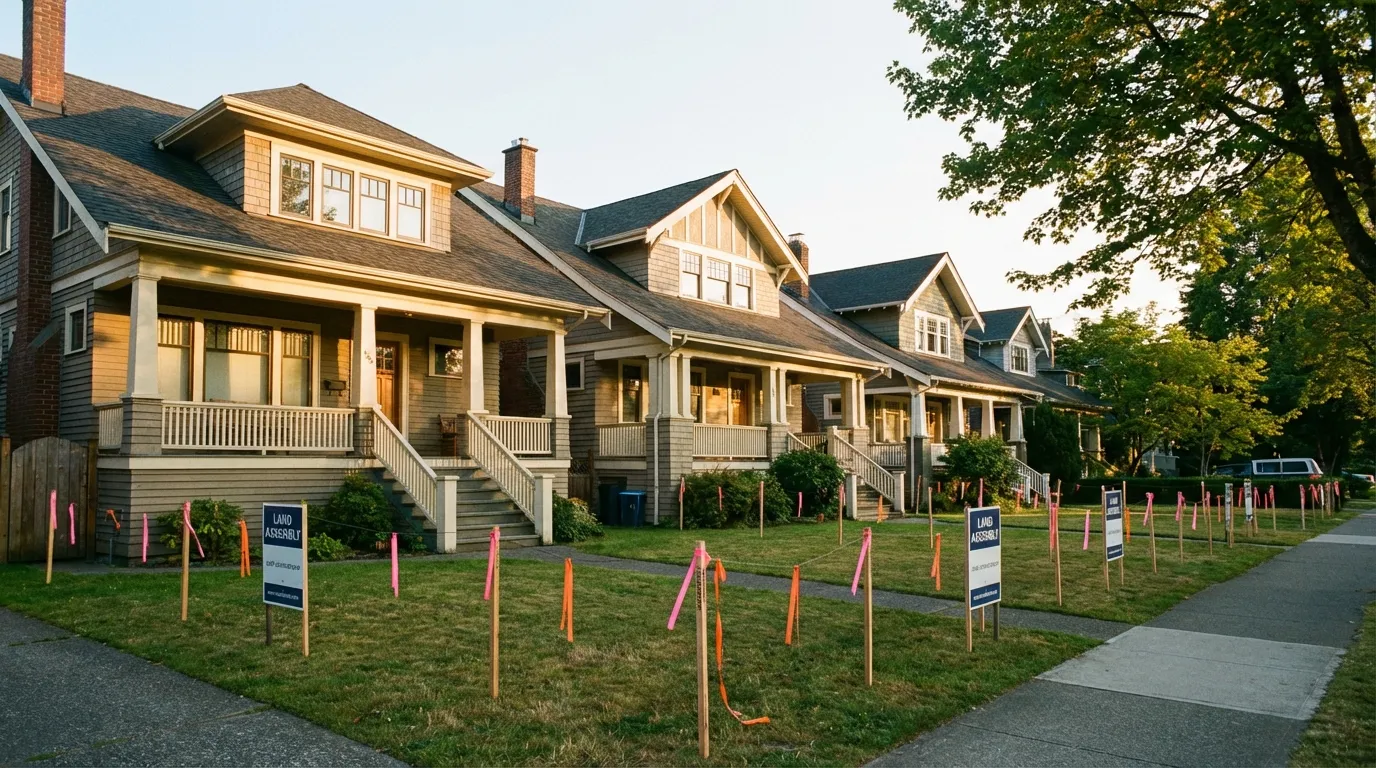
- Potential for land assembly
Common Mistakes to Avoid
Overpaying for “Potential”
Not every single-family lot makes a good multiplex site. Narrow lots, heritage restrictions, and challenging topography can kill feasibility. Always run numbers before bidding.
Underestimating Soft Costs
Permits, development cost charges, design fees, and holding costs add up quickly. Budget 15-20% of hard costs for soft costs.
Ignoring the Rental Market
Building a multiplex only works if you can rent the units. Study comparable rents in the specific neighbourhood—not just citywide averages.
Skipping Professional Analysis
A $5,000 feasibility study can save you $500,000 in mistakes. Work with architects and builders who specialize in SSMUH projects.
Frequently Asked Questions
How long does it take to build a multiplex in Vancouver?
From land acquisition to occupancy, expect 18-30 months. Permit timelines alone can be 8-12 months, with construction taking 10-14 months for a typical fourplex.
Can I convert an existing home into a multiplex?
Yes, depending on the structure. Many older homes can accommodate a secondary suite and laneway house. Full multiplex conversion may require significant structural work.
What’s the minimum investment to get started?
For a modest duplex development in an emerging neighbourhood, budget $2.5-3M all-in. Fourplexes in established areas typically require $4-6M total capital.
Should I develop and hold, or develop and sell?
This depends on your goals. Holding generates ongoing income and long-term appreciation. Selling captures immediate profit but triggers capital gains. Many investors hold the first 2-3 projects, then sell to recycle capital.
How does Vancouver compare to other municipalities?
Vancouver has the most established multiplex market, but Burnaby, New Westminster, and North Vancouver are implementing similar policies. First-mover advantage in Vancouver means more comparable sales data and clearer permit pathways.
Next Steps
The multiplex opportunity in Vancouver is real, but it requires expertise to execute profitably. From identifying the right lot to structuring financing and managing construction, the details matter.
At Rain City Properties, we work directly with investors and builders on multiplex acquisitions. Greyden Douglas maintains an active network of developers, lenders, and contractors who specialize in SSMUH projects. If you’re considering a multiplex investment, start with a 10-minute call to discuss your goals and budget.
Ready to explore multiplex opportunities? Contact Rain City Properties for a builder-ready lot analysis and current inventory of development sites.
Related Vancouver real estate pages
Continue with local service pages, neighbourhood guides, and actionable resources related to this topic.