A detailed analysis of building energy-efficient multiplexes in Vancouver, including BC Step Code requirements, heat pump costs, solar considerations, available incentives, and how green building affects your development ROI.
Building a net-zero or high-efficiency multiplex in Vancouver isn’t just about environmental responsibility—it’s increasingly about regulatory compliance, operating cost reduction, and market positioning. With BC Step Code requirements tightening and tenant preferences shifting toward energy-efficient homes, understanding the costs and returns of green building is essential for any multiplex development project.
This guide breaks down what it actually costs to build above-code, what incentives are available, and whether the investment pencils out for Vancouver developers in 2026.
BC Step Code: What You Need to Know
BC’s Energy Step Code is a provincial standard that sets progressive levels of energy efficiency for new construction. It’s not optional—municipalities adopt specific Step Code levels as requirements.
Step Code Levels Explained
| Level | Energy Reduction | Typical Use |
|---|---|---|
| Step 1 | Base BC Building Code | Minimum (being phased out) |
| Step 2 | ~20% better than code | Current minimum in many areas |
| Step 3 | ~40% better than code | Vancouver requirement 2022+ |
| Step 4 | ~60% better than code | Required by 2027 |
| Step 5 | ~80% better than code | Near net-zero ready |
Vancouver’s Current Requirements
As of 2026, Vancouver requires:
- Part 9 buildings (residential, up to 3 stories): Step 3 minimum, Step 4 by late 2027
- Part 3 buildings (larger residential): Step 2-3 depending on building type
For most multiplex projects (fourplexes, sixplexes under 3 stories), you’re building to Step 3 or higher today.
What Step 3 Means Practically
Meeting Step 3 requires meaningful upgrades over basic code:
- Enhanced insulation (walls, roof, foundation)
- High-performance windows (triple-glazed in many cases)
- Improved air sealing (blower door tested)
- Heat recovery ventilation (HRV)
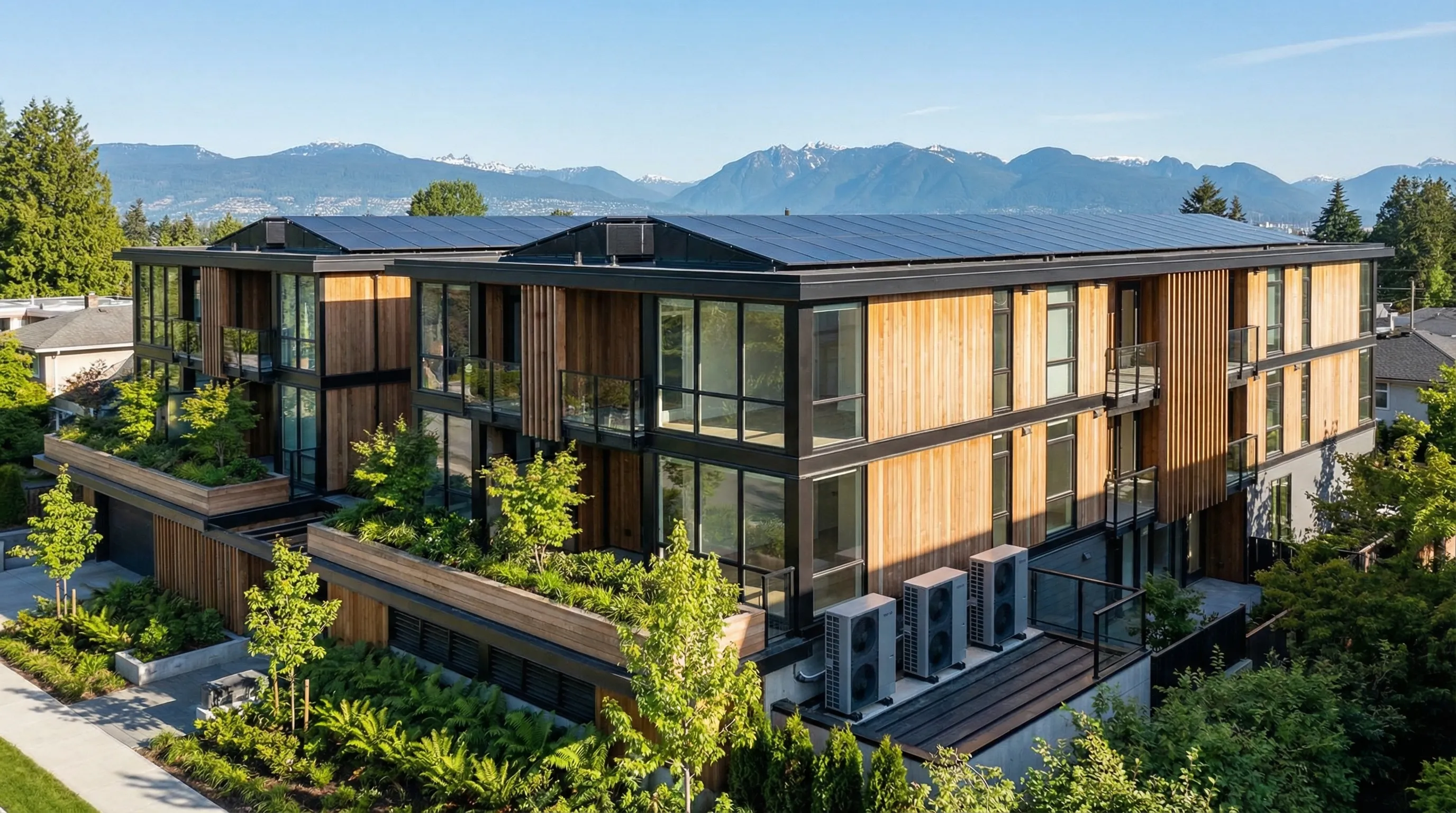
- Typically electric heat pump for space and water heating
Cost Premiums for High-Efficiency Building
Building to higher Step Code levels costs more upfront. Here’s what to expect:
Cost Premium by Step Level
| Step Level | Cost Premium | Per Sq Ft Premium | On $1.5M Project |
|---|---|---|---|
| Step 3 | 3-5% | $15-25/sf | $45,000-$75,000 |
| Step 4 | 5-8% | $25-40/sf | $75,000-$120,000 |
| Step 5 | 8-12% | $40-60/sf | $120,000-$180,000 |
| Net-Zero | 10-15% | $50-75/sf | $150,000-$225,000 |
These premiums cover the additional materials, systems, and sometimes design/engineering time required.
Breaking Down the Costs
Envelope Improvements (Walls, Roof, Windows):
| Component | Standard | Step 3-4 Upgrade | Cost Increase |
|---|---|---|---|
| Wall insulation | R-22 | R-28 to R-40 | $3-5/sf wall area |
| Roof insulation | R-40 | R-50 to R-60 | $2-3/sf roof area |
| Windows | Double-pane | Triple-pane, low-E | $50-100/window |
| Air sealing | Standard | Continuous membrane | $5,000-$10,000 total |
Mechanical Systems:
| System | Standard | High-Efficiency | Cost Premium |
|---|---|---|---|
| Heating | Gas furnace | Air-source heat pump | $5,000-$15,000/unit |
| Hot water | Gas tank | Heat pump water heater | $3,000-$5,000/unit |
| Ventilation | Bathroom fans | HRV system | $3,000-$6,000/unit |
| Cooling | None or portable | Integrated heat pump | Included above |
For a 4-unit multiplex, mechanical upgrades alone can add $40,000-$80,000.
Solar-Ready vs. Solar-Installed
Vancouver doesn’t require solar panels, but “solar-ready” construction is increasingly common:
Solar-Ready (conduit and panel space only): $2,000-$5,000 Solar Installation (3-5kW system per unit): $15,000-$25,000 per unit
Solar can offset common area electricity costs and may provide tenant amenity value, but the ROI for rental properties is longer than for owner-occupied homes due to complex utility billing.
Available Incentives and Rebates
Multiple programs can offset your green building premium:
BC Hydro New Construction Program
BC Hydro offers incentives for new residential construction exceeding Step Code requirements:
- Step 4 (when Step 3 required): Up to $5,000-$10,000 per unit
- Step 5 (near net-zero): Up to $10,000-$15,000 per unit
- Additional bonuses for all-electric buildings
For a 4-unit multiplex exceeding requirements by one Step level: $20,000-$40,000 potential incentive.
CleanBC Better Homes Program
While primarily for retrofits, some new construction elements qualify:
- Heat pump installation rebates
- Heat pump water heater rebates
- Solar system rebates (residential)
Federal Programs
- Canada Greener Homes Grant: Primarily for existing homes, but check for new construction components
- CMHC Green Home Premium Refund: Reduced mortgage insurance for energy-efficient homes (applies if you’re financing construction)
Municipal Incentives
Vancouver occasionally offers:
- Expedited permitting for high-performance buildings
- Density bonuses for exceptional environmental performance
- Property tax exemptions (rare, but worth checking)
Total Incentive Potential
For a high-efficiency multiplex project:
| Incentive Source | Potential Amount |
|---|---|
| BC Hydro | $20,000-$60,000 |
| CleanBC rebates | $5,000-$15,000 |
| CMHC insurance refund | $5,000-$10,000 |
| Total | $30,000-$85,000 |
This can offset 30-50% of your green building premium.
ROI Analysis: Does Green Building Pay Off?
Let’s run the numbers on a typical multiplex project:
Scenario: 4-Unit Multiplex in East Vancouver
Base Project:
- Land cost: $1,600,000
- Standard construction (Step 3 minimum): $1,400,000
- Total project cost: $3,000,000
- Rental income (4 × $2,800/month): $134,400/year
- Operating costs: $25,000/year
- Net operating income: $109,400/year
- Cap rate: 3.6%
Enhanced Project (Step 4-5):
- Land cost: $1,600,000
- High-efficiency construction: $1,500,000 (+$100,000)
- Less incentives received: -$50,000
- Net additional cost: $50,000
- Total project cost: $3,050,000
- Rental income (4 × $2,950/month—green premium): $141,600/year
- Operating costs: $20,000/year (energy savings)
- Net operating income: $121,600/year
- Cap rate: 4.0%
The Math Breakdown
| Factor | Impact |
|---|---|
| Additional construction cost | +$100,000 |
| Incentives received | -$50,000 |
| Net premium | +$50,000 |
| Rental premium ($150/unit × 4 × 12) | +$7,200/year |
| Operating cost savings | +$5,000/year |
| Annual benefit | +$12,200/year |
| Simple payback | 4.1 years |
After the payback period, the enhanced building generates $12,200 more annually than the standard building—while providing better tenant comfort and lower environmental impact.
The Green Premium in Rents
Can you actually charge more for energy-efficient units? Market evidence suggests yes:
- BC Hydro studies: 5-10% rental premium for high-efficiency units
- Tenant preferences: Surveys show willingness to pay more for lower utility costs
- Vancouver rental market: Premium amenities (in-suite laundry, A/C, heat pumps) command higher rents
Conservative estimate: $100-$200/month premium per unit for demonstrably energy-efficient construction with features like heat pumps (providing A/C), quiet HRV ventilation, and lower utility bills.
Long-Term Value Considerations
Beyond annual cash flow:
- Resale value: Energy-efficient buildings may command premium prices as regulations tighten
- Regulatory risk: Buildings meeting only minimum code may face costly upgrades later
- Tenant retention: Lower utility costs and better comfort reduce turnover
- Insurance considerations: Some insurers offer discounts for modern, resilient construction
Practical Building Strategies
Start with the Envelope
The most cost-effective efficiency gains come from the building envelope:
- Continuous insulation: Wrap the building in rigid foam before siding
- Air sealing: Invest in proper air barrier installation—it’s cheap and highly effective
- High-performance windows: Triple-pane pays for itself in Vancouver’s climate
- Thermal bridge mitigation: Detail connections carefully to prevent heat loss
Right-Size the Mechanical Systems
With a good envelope, you can use smaller, less expensive mechanical systems:
- Better insulation = smaller heat pump capacity needed
- Proper air sealing = more efficient HRV operation
- Solar orientation = reduced heating and cooling loads
Consider All-Electric Early
Designing for all-electric from the start is cheaper than adding gas infrastructure:
- No gas line connection fee ($5,000-$10,000 saved)
- No gas meter and monthly charges
- Simpler mechanical room design
- Eligible for additional electric-only incentives
Work with Experienced Contractors
Not all builders understand high-performance construction. Seek:
- Contractors with Step 4-5 project experience
- Energy advisors familiar with BC Step Code
- Trades trained in air sealing and heat pump installation
Inexperienced contractors can eat up your budget with mistakes and rework.
Step Code Compliance: The Permitting Process
Energy Modeling Requirements
For Step 3 and above, you’ll need:
- Pre-construction energy model: Submitted with building permit
- Design review: City checks compliance with Step Code targets
- Testing during construction: Blower door test at specific stages
- Final testing and documentation: Proof of compliance before occupancy
Budget for Energy Consulting
Energy modeling and testing typically costs:
- Initial energy model: $3,000-$6,000
- Blower door testing: $500-$1,000 per test
- Final documentation: $1,000-$2,000
- Total: $5,000-$10,000 for a multiplex project
Common Compliance Pitfalls
Issues that cause delays and added costs:
- Failing blower door tests (air sealing deficiencies)
- Windows not meeting specified performance
- Insulation installation quality issues
- Mechanical systems not matching model specifications
Key Takeaways
- BC Step Code requirements are mandatory and increasing—plan for Step 4 even if Step 3 is current minimum
- Building to Step 4-5 costs 5-12% more but incentives can offset 30-50% of the premium
- Green building premiums can be recovered in 3-5 years through rent premiums and operating savings
- Focus investment on envelope improvements first—they provide the best ROI
- All-electric design simplifies construction and qualifies for additional incentives
- Work with contractors and consultants experienced in high-performance building
Frequently Asked Questions
Is net-zero construction required in Vancouver?
No, net-zero is not currently required. Vancouver requires Step Code 3 for most residential construction, with Step 4 coming by 2027-2028. Net-zero (Step 5 or beyond) is voluntary but may be required by 2030 for new construction. Building to higher standards now future-proofs your investment.
How much do heat pumps add to construction costs?
For a multiplex, expect $5,000-$15,000 per unit for air-source heat pump systems providing both heating and cooling. This replaces gas furnace costs, so the net premium is $3,000-$10,000 per unit. Heat pumps also provide air conditioning, which adds tenant value and rental premium potential.
Do tenants actually pay more for energy-efficient units?
Market evidence suggests a 5-10% rental premium is achievable for demonstrably energy-efficient units, particularly those with heat pumps (providing A/C), low utility costs, and modern ventilation. In Vancouver’s rental market, premium amenities consistently command higher rents.
What’s the payback period for building above Step Code minimum?
With available incentives and conservative rent/operating cost improvements, typical payback periods are 3-5 years for Step 4 construction and 5-8 years for Step 5/net-zero. After payback, the enhanced building generates higher net income indefinitely.
Should I install solar panels on a rental multiplex?
Solar on rentals is complicated by utility billing—tenants receive the benefit but you pay the capital cost. Consider: solar-ready construction (cheap, keeps options open), solar for common areas only (offsets your costs directly), or including utilities in rent (allows you to capture savings). Pure investment returns are better for owner-occupied buildings.
Work with Rain City Properties
Building a high-performance multiplex requires understanding both construction details and development economics. The right balance of efficiency investment, incentive capture, and rental positioning determines whether your project meets financial targets while contributing to Vancouver’s sustainability goals.
Greyden Douglas works with developers and investors across Vancouver’s west side, providing market insight on what efficiency features drive rental premiums in different neighbourhoods. With established relationships with builders experienced in high-performance construction, Rain City Properties helps you navigate the technical and financial aspects of green multiplex development.
Contact Greyden Douglas directly at (604) 218-2289 or book a call to discuss your multiplex development project.
Related Vancouver real estate pages
Continue with local service pages, neighbourhood guides, and actionable resources related to this topic.